• You're one step from joining Hammock Camping Forum – Ultralight Gear, DIY Setups & Backcountry Tips.
    Create a free account to post, follow threads, and never miss an update.  Sign up free →

Picking the right hammock straps size

cjjjjjjjj

Member
Joined
May 19, 2025
Messages
6
Mostly hiking Utah and Colorado and bringing a hammock for trail breaks. Considering Kammok Python Straps. They come in two lengths and I'm wondering how often the extra reach would come in handy. Anyone got advice for trees in this region?
 
I prefer using short, lightweight tree huggers (straps w/ a loop at each end) and several feet of dyneema UCRs to connect between the huggers and the continues loop (CL) on the hammock.
Python straps are heavy.
 
The 15s can be good for most spots but in many parts of Utah and Colorado, especially at higher elevations, you'll see a mix of trees. how about checking out python 15s instead for longer straps which is better for larger trees
 
@LowTech Appreciate the insight. Weight is definitely a factor so the lighter setup is tempting. How do the UCRs hold up in rougher conditions? I'm aiming for reliability since my trips can get pretty spread out.

@coinh0pper It's good to know about the variety of trees at higher elevations. The extra length could come in handy when options are limited. Have you found yourself needing the full reach often or is it more of a backup for tricky spots?
 
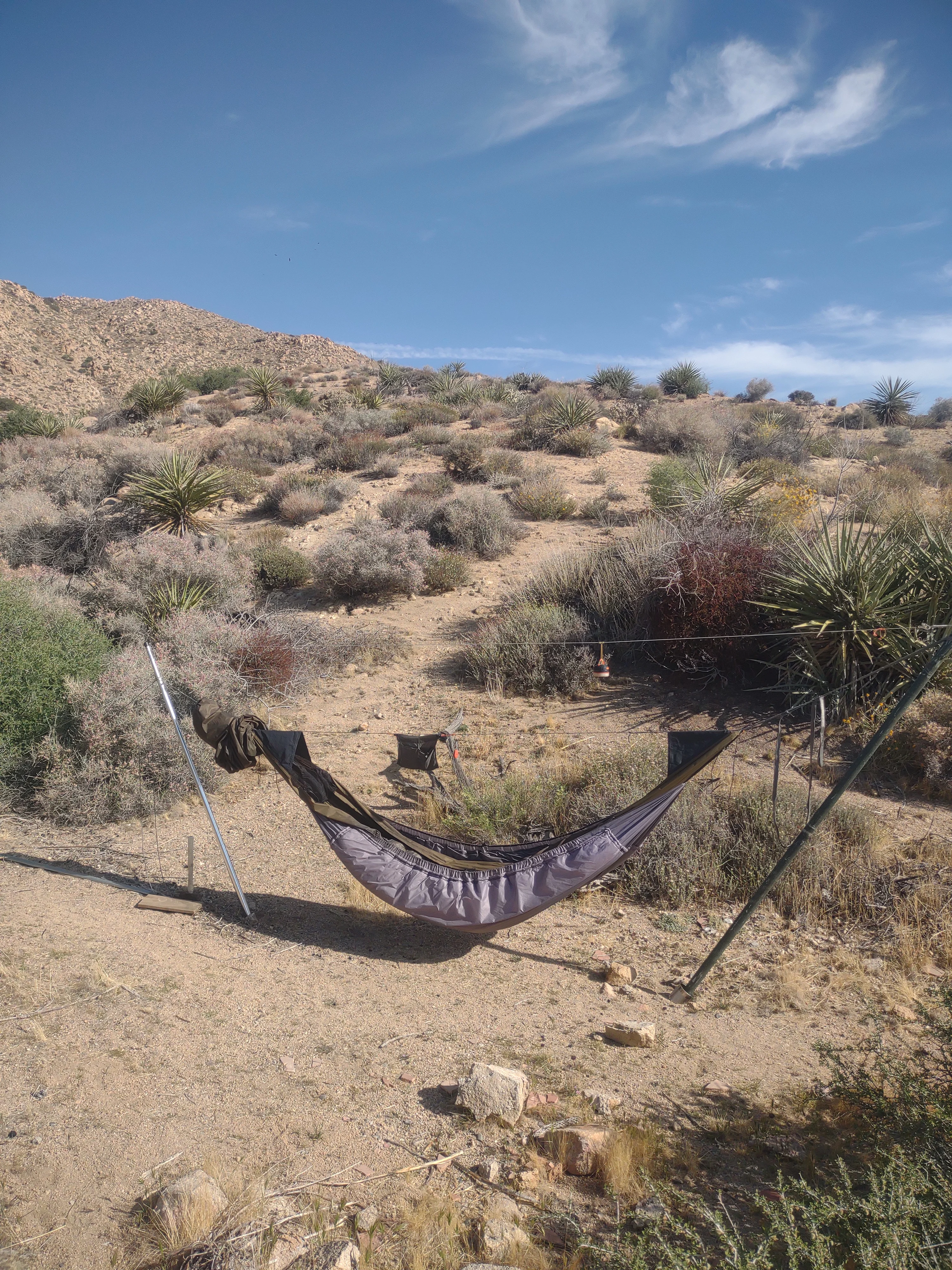
I'm in my hammock, outside, in the desert mostly, every night. Being in the desert I'm using a pole stand more than 95% of the time. The guy lines that I use to hold the poles up are 7/64 dyneema line that I spliced together as UCRs a few years ago . . . so pretty constant exposure to the elements and they're not even close to failing. When I go somewhere that has trees I use the one of the same UCRs to attach one end of the hammock to my tree hugger. I've learned that I really only use one and a dogbone on the other end surfices as I can adjust that end by doubling, or tripling, the dogbone and then make fine tuning adjustments on the UCR (head) end.

This is my current bedroom,

IMG_20250501_084513860.webp
 
Mostly hiking Utah and Colorado and bringing a hammock for trail breaks. Considering Kammok Python Straps. They come in two lengths and I'm wondering how often the extra reach would come in handy. Anyone got advice for trees in this region?
I used to hike a lot in CO, my cousins live there, and I'd strongly advise the longer Python Straks
While you'll find plenty of close trees, there are also many times when that extra reach is a lifesaver. Plus, thicker trunks can eat up a lot of strap length
 
@LowTech That's a heck of a field report on the UCR durability. Thank you for that detailed breakdown. Your single UCR and dogbone setup is next-level stuff and gives me a lot to chew on for a future ultralight build. You've really got that system dialed in.

@DonutKing Appreciate you weighing in with that on-the-ground Colorado experience. That's exactly the kind of info I was looking for and your point about thick trunks eating up strap length really hits home. It appears the longer straps are cheap insurance against being stuck without a good spot to hang.
 
In the Pacific Northwest, the extra length is necessary for the tree diameter, not the tree distance. When I began hammock camping, I went up to a tree and figured out what the maximum, comfortable, vertical reach would be for me. Note that the further apart the trees, the higher you have to reach to stay in that 30° angle zone. With that information, I knew my preferred suspension length, plus what was necessary for the tree diameter. Much later, to my chagrin, I realized it's the tarp, not the hammock, that designates the distance.

For simplicity, I use a daisy chain and a carabiner for hammock suspension. That's because I am often responsible for more than one hammock setup and with the carabiner it's "clip and no concerns", rather than having to check a bury. I'm strong enough to deal with a few extra ounces. And, for full transparency, I'm more often kayak camping; weight and bulk are less of an issue.

Pacific Northwest Trees
1751304941276.webp
 
In the Pacific Northwest, the extra length is necessary for the tree diameter, not the tree distance. When I began hammock camping, I went up to a tree and figured out what the maximum, comfortable, vertical reach would be for me. Note that the further apart the trees, the higher you have to reach to stay in that 30° angle zone. With that information, I knew my preferred suspension length, plus what was necessary for the tree diameter. Much later, to my chagrin, I realized it's the tarp, not the hammock, that designates the distance.

For simplicity, I use a daisy chain and a carabiner for hammock suspension. That's because I am often responsible for more than one hammock setup and with the carabiner it's "clip and no concerns", rather than having to check a bury. I'm strong enough to deal with a few extra ounces. And, for full transparency, I'm more often kayak camping; weight and bulk are less of an issue.

Pacific Northwest Trees
View attachment 11
Thank you for sharing your methodology! The picture is an excellent visual of tree diameter being a huge aspect. I hadn't considered that the tarp is the real limiting factor for distance. What length ridgeline do you find works best for your primary tarp setup?
 
An interesting question - because I followed what others have posted, my posts become part of that knowledge pool. My numbers might also come from commercial (for sale) ridge lines. A common figure is 35 feet. But so often it seems I have a lot of line left over. So I could get by with 30 ft ... until I can't. You could try 30 ft and carry a 5-foot extension. But really, it depends on the trees you'll encounter. They are not all as big as the one in the photo. Then again ...

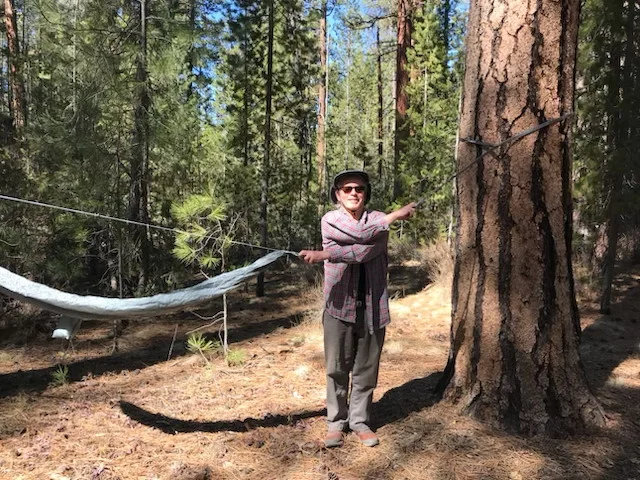
Just a hiking hammock (Grand Trunk Nano) and trees at Benham Falls, local spot in Bend OR
BenhamHammock.webp


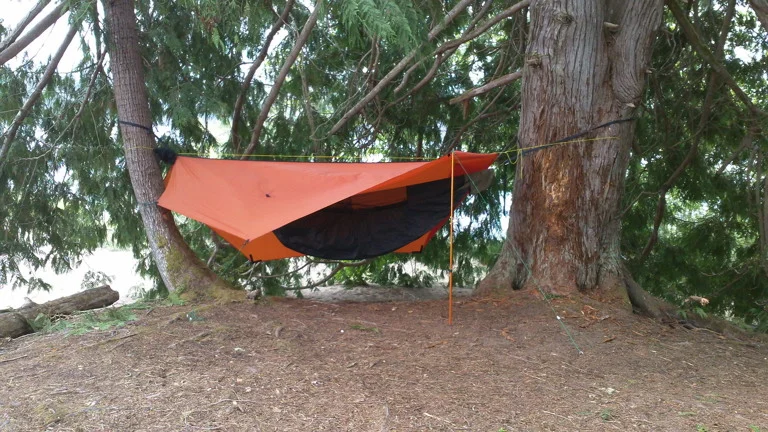
Here is a setup on Tivoli Island in Ozette Lake (NW Washington). Look at that tree on the right. Looks like I used almost all of that 35 feet. Such things aren't common, but they can happen. Dyneema Line weight is not something I worry about. It's more a personal fussiness about having to deal with a bunch of extra cord. I think 30 ft, with a spare 5 ft extension, might cover a lot of situations.

OzetteTree.webp


Two 2 ft diameter trees = (6.25 ft * 2) = 12.5 + 11 ft tarp =23.5 ft + (2ft * 2) from tarp to tree = ... say 26 ft. So 30 ft and carry an extra 5 ft just in case. My extra line has a hook at one end and a loop at the other, so I hook my main line to the extension loop, and I have 5 extra feet with a hook at the free extension end. I have some titanium hooks from Dutchware, but I like my metal "mitten hooks" because they are a little larger and easier to work with. I break out the "tongue" so it's just an open hook. They may not be as strong, but so far I haven't had a problem. Most of the "pull" is absorbed by the line friction around the tree; there isn't so much on the hook itself.

Note that, at first, I'd bring the hammock suspension and the tarp ridgeline off the middle of the tree. That puts a lot more strain on the hook. Nowadays, I always come off the side of the tree. It's kinder to all things involved.
 
Last edited:
Running a 30ft line with a 5ft extension makes setup way easier without dragging extra cord around each time, smart way to keep it simple and versatile.
 
Very informative thread, this caught my eye since I am in the same boat. I've learned a lot from this discussion!
 
Yeah, totally! I agree. This thread was super helpful. I feel like I actually know what I'm doing now for my next camping trip.
 

Latest posts

Back
Top