• You're one step from joining Hammock Camping Forum – Ultralight Gear, DIY Setups & Backcountry Tips.
    Create a free account to post, follow threads, and never miss an update.  Sign up free →

Hammock Hunt: Key Things to Know Before You Buy

Alan

Administrator
Staff member
Admin
Moderator
Joined
Feb 21, 2025
Messages
147
Hi all, I'm back and I'm here to talk and ask about what are the things you consider before getting a hammock. Few things beat the feeling of swaying gently under the trees or setting one up indoors for a cozy reading nook.

But before you dive in, there are a few key things worth weighing up.

Material: Cotton feels soft and breathable, while polyester or nylon are more durable and weather-resistant.
Size: Single hammocks are snug, but if you plan to share (or just sprawl), a double might be the way to go.
Style: Rope hammocks, Brazilian hammocks, camping hammocks, each has its own vibe and comfort level.
Weight capacity: Always check the rating so you don’t end up with a saggy surprise.
Setup options: Do you have trees or posts handy, or will you need a stand? Portability matters too if you’re a camper.
Accessories: Bug nets, rain tarps, underquilts, these can make or break your hammock experience outdoors.
Budget: Prices range from budget-friendly basics to handcrafted beauties. Think about how often you’ll use it.

I’d love to hear from the community: What’s your go-to hammock setup? Do you swear by a certain brand or style, or do you have DIY tricks for hanging one up?
 
Alan, I just had one eyebrow raise with your list - Weight capacity. If you exceed that, it's not that the hammock will sag; it will Break! Trees may fall, etc. Maybe. Because, as with most products, there is some "safety factor" over-engineering. If your hammock is rated at 250 lbs, and either by your weight, or rigging it up with a shallow hang angle that stresses it to 270 lbs, it might hold up. Maybe.

To be painfully and repeatedly clear, the weight rating is based on a static (no bouncing) load, hung at about a 30° angle, which results in the pull stress on the hammock suspension, material, and stitching being about the same as the weight in the hammock.

250 lbs in the hammock, hung at a 20° angle, results in a stress of about 365 lbs.

HOWEVER - if your hammock has a ridgeline, the forces are transferred from the suspension to that ridgeline so the hammock material and its stitching are spared.

The further away you are from that Max weight (towards the low side), the more you can get away with on that hang angle. But you want that sag (at 30° hang angle) so the hammock body is loose enough for a comfortable diagonal lie, relative to the hammock center line.

These days - winter - I sleep outside the house, in the front entrance way (under a roof) - in a RidgeRunner (bridge Hammock). The Lynx UQ (underquilt) is rated at 0° and my top quilt is rated at 20°, The hammock is ensconced in a full sock - not so much for the extra warmth as a shield from the light pollution by the neighbor's house (lights on till 2 AM) and a Freeway style street light - that the city says is no longer required by code - but they won't remove it.

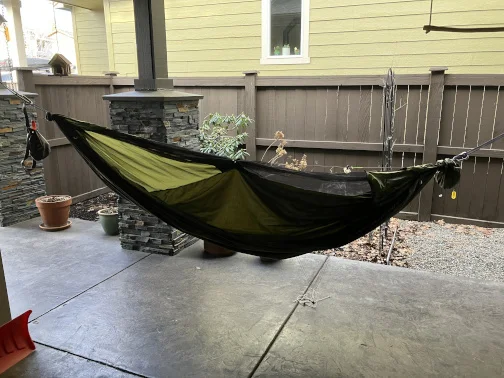
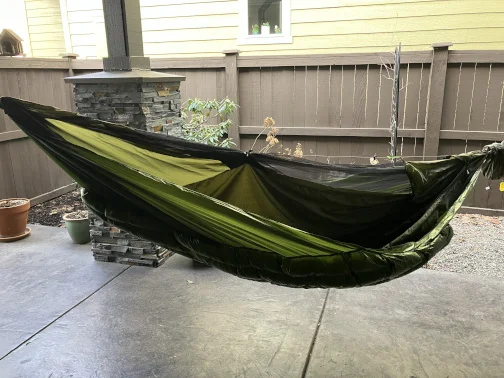
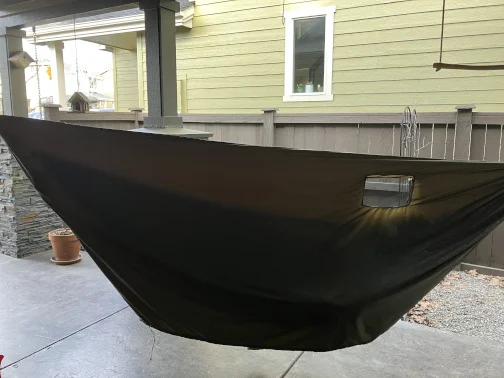
I don't want to set up the ridgerunner right now (I take it down every day) because I might go out to the desert tonight to watch the meteor shower. So here's a typical setup in the warmer seasons: A single-layer WarBonnet BlackBird, then a 30° Wookie underquilt added, and finally a OneWind shroud for privacy and light shielding.
FirstTheHammock.webp

ThenTheUnderQuilt.webp

FinallyTheShroud.webp
 
Good reminder, @cougarmeat! Appreciate that. manufacturers build in a safety margin, but it’s not unlimited. Agree, hang angle and ridgeline use make a big difference in how long gear lasts and how safe it feels.

Nice combo on your setup by the way! Looks like you’ve got your bases covered. A 0° underquilt paired with a 20° top quilt is a common balance for winter hammocking, and the sock adds that extra shield against light and wind.
 
You'll note the raised foot end. That is recommended by Warbonnet for the BlackBird design because of the built-in foot area. They recommend about an 18-inch height difference (that seems extreme). The usual difference for a GE hammock is closer to 8 to 10 inches. Why the foot-end raise? Because the nylon is slippery, as you relax during the night, you tend to slide down toward the foot end. Raising the foot end a bit doesn't put you in a Head-Down position. It sort of levels things out so you don't end up at the foot end of the hammock in the morning.
 

Latest posts

Back
Top