• You're one step from joining Hammock Camping Forum – Ultralight Gear, DIY Setups & Backcountry Tips.
    Create a free account to post, follow threads, and never miss an update.  Sign up free →

How essential is to have a tarp?

Thejungler

New member
Joined
Jul 16, 2025
Messages
2
I know what it's for and all that, but I'm interested to know in how essential it would be? I don't plan on going anywhere if it's raining and I'm generally aiming for thick forests where the sun isn't a massive issue. Can I go without one?
 
There are more things that fall from the sky besides rain. Just look at some parked cars. You did mention the forest as a sun, and I assume moon, shield. What about a falling pine cone? The deal is, you can imagine the ideal setup, but a lot of gear falls in the "just in case" category. Some people proudly claim, "You carry your fears." For me, I'd counter with, "You carry your experiences."

There are all kinds of "schools". I am not in the "ultralite" school. I like a big tarp - but made out of silpoly, not canvas - so the hammock is covered and I have a dry area outside the hammock. But, if I knew with a high probability that there would be no rain, I'd carry one of the smaller tarps, like a WarBonnet MiniFly.

The best way to evolve is to go out, preferably solo, on short-distance outings - so you can retreat to the car if something completely unforeseen happens. My mind harkens back to the time it snowed !!! around the 4th of July in the Strawberry Mountains (Oregon).

I mention solo excursions because you suffer your mistakes (learning experiences) privately. And you may be more willing to try iffy things (like leaving the tarp and/or bugnet at home) that you might not when concerned for a 2nd party.

If you have a place at home, or a nearby park, where you can set up your hammock, you can practice and find the rhythm that works for you. Find out how high above the ground you like your hammock, how much sag (that allows you to turn a bit diagonal, leveling out the lie), what kind of suspension you prefer, etc.

Also - yes, I could go on and on :) - you can find out what temperature ratings work for you. For example, say a top quilt is rated at 40°. I would switch from my warmer gear to that once the nighttime temps were in the 50s or high 40s. I prefer a 10° cushion in the gear rating over the expected temps.

You could use your camping sleeping bag (open like a top quilt), but you'll need some form of insulation under you.

These are things it's best to learn when you are not hiked in 10 miles from your car.
 
Last edited:
Even in thick woods, unexpected weather can pop up, and a tarp can add some warmth and shelter if you want to hang out outside your hammock but if you're okay with being a bit more exposed and tend to plan around the weather, you can skip it and still have a solid setup
 
I know what it's for and all that, but I'm interested to know in how essential it would be? I don't plan on going anywhere if it's raining and I'm generally aiming for thick forests where the sun isn't a massive issue. Can I go without one?
Yeah, you can skip it if you're avoiding rain and open sun, people overhype gear sometimes. If you're smart about your trips, it's not exactly essential
 
There have been several times that I went tarpless outside of my usual SWestern deserts and woke up to a dew soaked, down, topquilt. Hell, even a few times in the desert, a day or two after a good rain (pretty much the only time we get dew), that I got a soaked TQ for the same reason.
Just in the last few weeks there was a day when we got a a serious monsoon rain and by the time I was ready to sleep the sky was empty w/ a nice moon and a gentle breeze . . . I put the tarp out anyways, but loose and high. Around 3:30 a major storm hit. I spent about 45 minutes sitting in my hammock w/ a hand on either side of the hammock holding the bottom edge of my tarp down while the storm beat on me. This was a full coverage tarp, w/ "doors" that I hadn't closed and there wasn't a chance I was going to let go of the tarp to sort them out while the wind was gusting up to 40mph. At the end my UQ was seriously "damp" (synthetic) from the rain coming in the end of the tarp but I was able to lay back down and finish the night w/ out fear of hypothermia.
If I hadn't had my tarp out I'm not sure I could have put it up before getting slammed and everything being soaked . . . Not a situation I'd want to be in far from a "bailout" option.

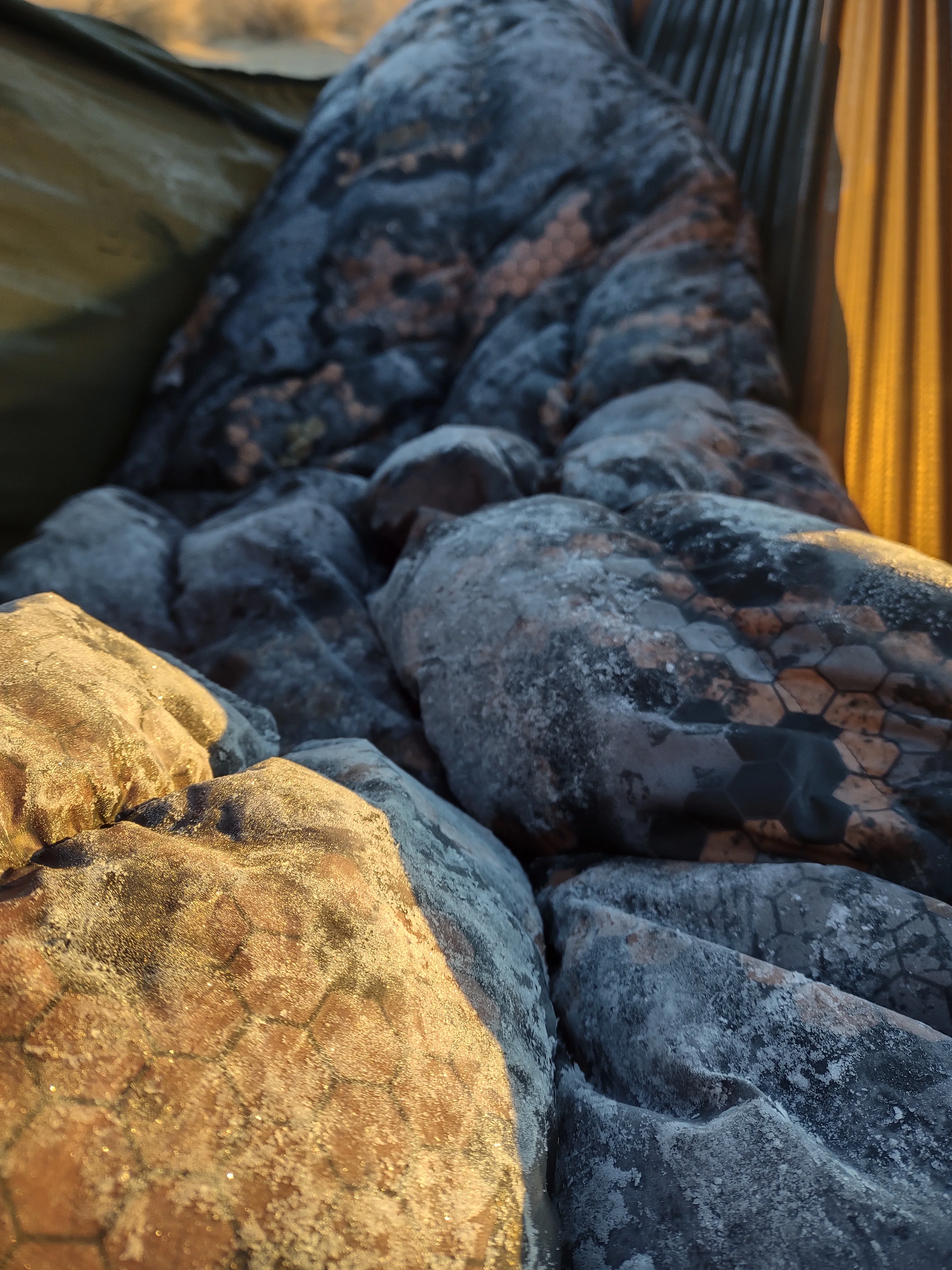
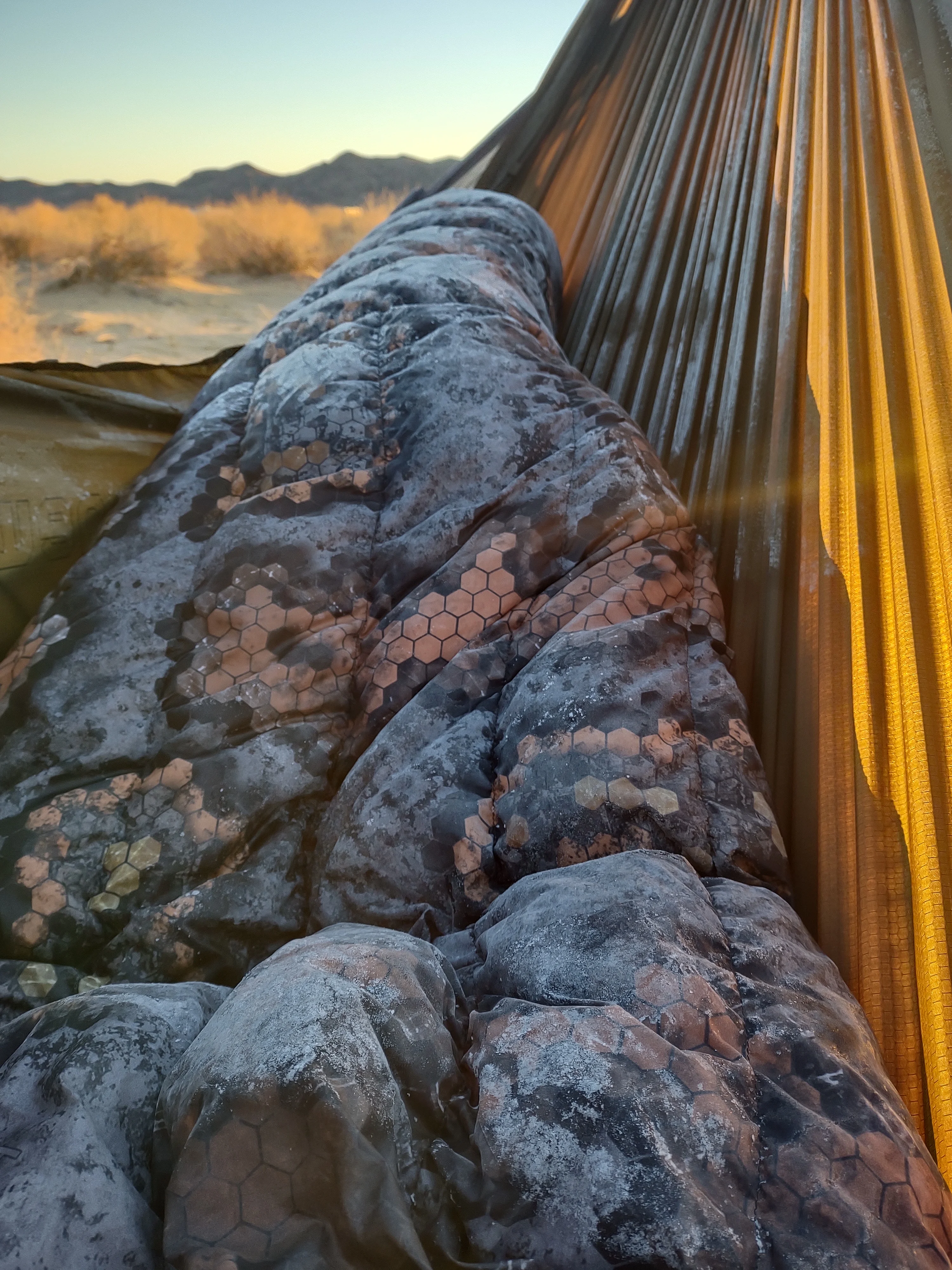
Here's a time that I went tarpless w/ not a cloud in the sky only to wake up at dawn cold w/ a very frost damp TQ,
IMG_20230331_064754927_HDR.webp


IMG_20230331_064805982_HDR.webp


Then there was that time bikepacking that we camped in a little creek valley, again in the desert, and not only did it drop 20° below forcasted temps but again wet my lightweight summer TQ. The only thing that saved me that night was that I had put on the bugnet to cut a breeze and it stopped a lot of the moisture from settling inside.
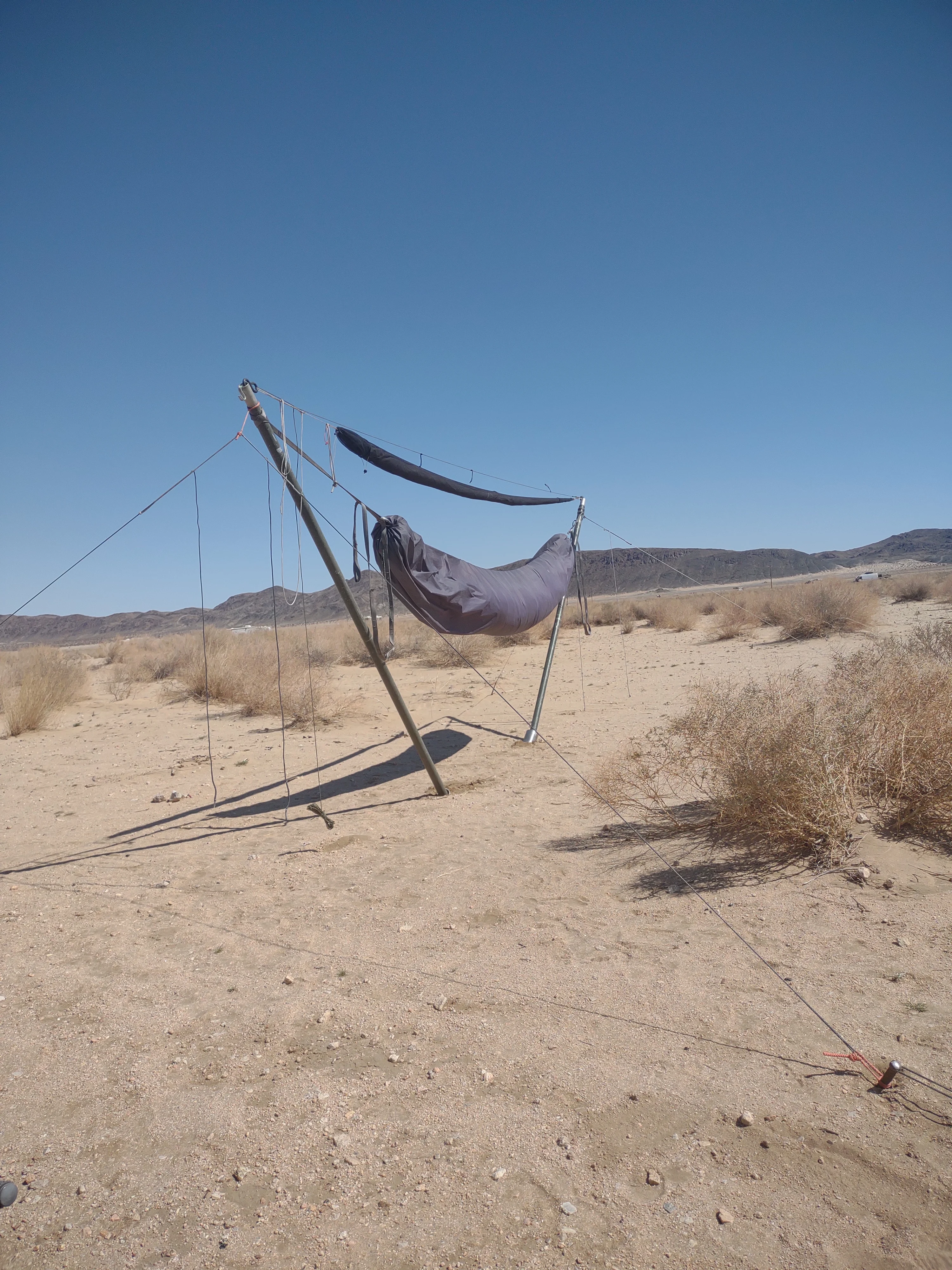
Now my tarp is always w/ me and almost always up, though not out. I keep it in what's known as a "snakeskin", a mesh tube that allows me to have it up but not spead out. When stakes are already set in the ground I can jump up and have my tarp spead out in about 15 secs. Perfect for when you want to see the sky but still have tarp coverage when needed. Plus my full coverage tarp probably weighs less than a pound, so why would I leave it behind?
IMG_20230405_105512258.webp
 
You know, it's surprising how quickly things can get damp, even when it's not raining. Just a bit of unexpected condensation can turn your gear into a soggy mess in no time. That's why carrying a lightweight cover can feel like a lifesaver if you're camping out under the stars
 

Latest posts

Back
Top