• You're one step from joining Hammock Camping Forum – Ultralight Gear, DIY Setups & Backcountry Tips.
    Create a free account to post, follow threads, and never miss an update.  Sign up free →

Me and my short tree straps

philippe_1998

Member
Joined
Dec 3, 2025
Messages
8
On my last camping trip I found my straps weren’t long enough for the giant trees at the site. I ended up improvising with some rope, which.. let’s just say wasn’t my best idea. 😂 Do you all pack extra‑long straps for situations like that or stick with the standard ones? And any recs for good straps?
 
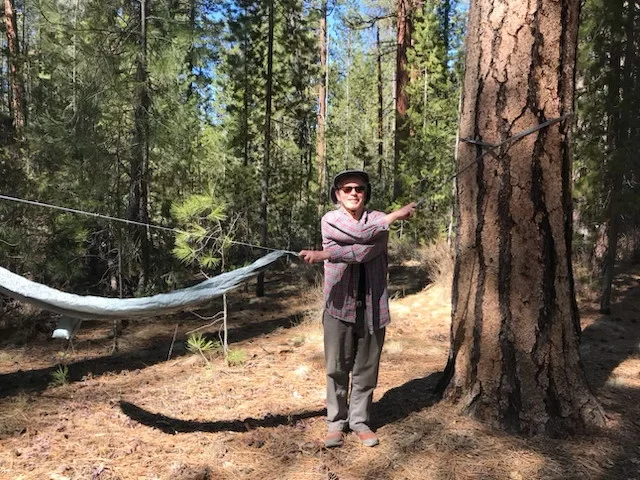
These days I pack a TensaOutdoor Solo pole. I don't need two trees, but I do have the challenges of a proper anchor.
BenhamHammock.webp
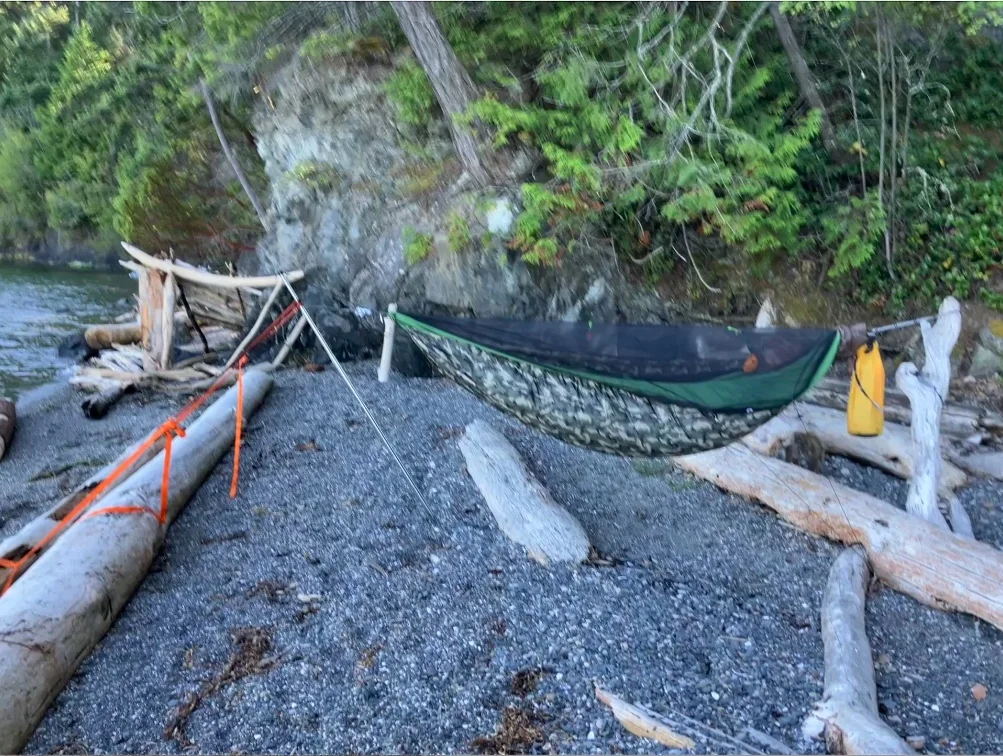
PelicanBeach1.webp
 
I do have different length straps, or huggers, which I choose beforehand and I always carry some dyneema dog bones, at least 1× 6' & 2× 3'.
If the straps I brought are to short I can add in the dog bone. Just keep the strap on the far side of the tree where it could be damaged by the thinner line. If you position your straps correctly only the far half of the tree gets real pressure on the bark.
 
cougarmeat always has the coolest pics! hehe
btw, OP, just buy a strap extension. I keep a pair of ENO Atlas EXT in my kit. They add an extra 54 inches to whatever you're already using. It’s a cheap way to make sure all of your gears are fit for those sites with giant old growth trees
 
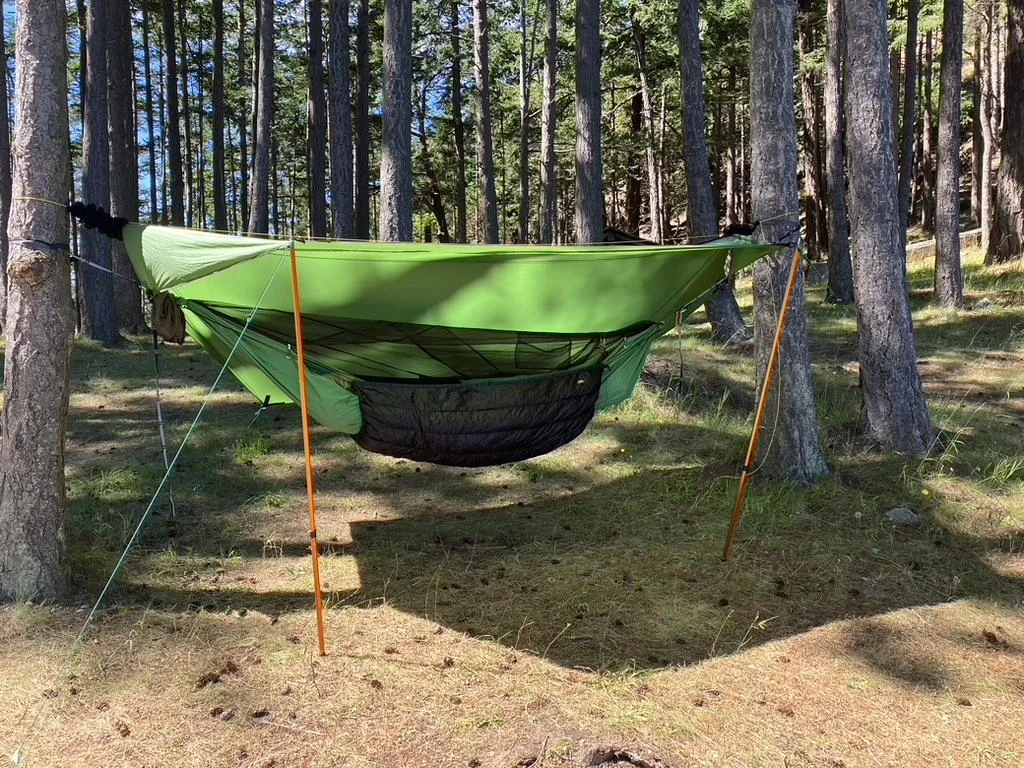
JamesHammock.webp


Sometimes everything works.
Location is James Island, the San Juan islands, Washington.
Trees of reasonable diameter.
Tarp is Warbonnet MiniFly; enough for the anticipated weather on this trip, plus, I always have an extra tarp to cover an eating area. Note that I am using a two-piece mesh snakeskin, with each side pushed up on the extra tarp ridgeline between the tree and the tarp itself.
Hammock is a single-layer Warbonnet BlackBird. I don't need the extra size of the XLC model. I don't need the double-layer option of my first BlackBird.
Underquilt is ¾ length HammockGear 40° Phoenix
Collapsible poles are REI.
Finesse: Note the headend is slightly lower than the foot end. It keeps me from sliding to the foot end during the night. I am still "flat". It's not like sleeping on the ground with my head lower (blood rush to head) than my feet. The foot end hang angle is not quite 30°, but the built-in ridgeline handles the forces.

A beautiful sunny day brought to you by the deity of your choice.

Full Story at: https://tinyurl.com/3swsjea

Note that on another visit, I tried to set up in this exact location, in the wind. What a fiasco. I learned three things on that trip.
1. Set up in a weather-sheltered area. You can always walk the 10 or so extra yards to the viewpoint
2. Store the tarp in a "snakeskin," exposing it to the weather a little at a time, securing as you go, so the whole thing doesn't become one big sail.
3. While there, another couple left their camp area to enjoy the view. They had hung food in light nylon bag. Ravens pecked through that bag in maybe under a minute. I would have chased the birds away, but the situation only caught my eye as the food fell out. I now store my food in a Garcia Barrel or Ursack (the model designed to thwart smaller critters, not bears). And I store it away from where I sleep.
 
Last edited:
View attachment 62

Sometimes everything works.
Location is James Island, the San Juan islands, Washington.
Trees of reasonable diameter.
Tarp is Warbonnet MiniFly; enough for the anticipated weather on this trip, plus, I always have an extra tarp to cover an eating area. Note that I am using a two-piece mesh snakeskin, with each side pushed up on the extra tarp ridgeline between the tree and the tarp itself.
Hammock is a single-layer Warbonnet BlackBird. I don't need the extra size of the XLC model. I don't need the double-layer option of my first BlackBird.
Underquilt is ¾ length HammockGear 40° Phoenix
Collapsible poles are REI.
Finesse: Note the headend is slightly lower than the foot end. It keeps me from sliding to the foot end during the night. I am still "flat". It's not like sleeping on the ground with my head lower (blood rush to head) than my feet. The foot end hang angle is not quite 30°, but the built-in ridgeline handles the forces.

A beautiful sunny day brought to you by the deity of your choice.

Full Story at: https://tinyurl.com/3swsjea

Note that on another visit, I tried to set up in this exact location, in the wind. What a fiasco. I learned three things on that trip.
1. Set up in a weather-sheltered area. You can always walk the 10 or so extra yards to the viewpoint
2. Store the tarp in a "snakeskin," exposing it to the weather a little at a time, securing as you go, so the whole thing doesn't become one big sail.
3. While there, another couple left their camp area to enjoy the view. They had hung food in light nylon bag. Ravens pecked through that bag in maybe under a minute. I would have chased the birds away, but the situation only caught my eye as the food fell out. I now store my food in a Garcia Barrel or Ursack (the model designed to thwart smaller critters, not bears). And I store it away from where I sleep.
That setup looks amazing! I’m a little jealous of that calm, sunny James Island day you scored.

Your note about the head‑end being slightly lower caught my attention. I’ve always done the opposite because that’s what I was taught early on, but your reasoning makes sense. Do you find that adjustment changes how your underquilt sits at all, or does the Phoenix stay put without fiddling?

Sounds like an awesome trip!
 
No change in "fit". I think many of us were taught, or experienced, that sleeping on the ground is more comfortable if we are level or on a shallow slope, which is better for drainage, with our feet lower than our head. In a hammock, a height difference of 6 to 10 inches (that's at the hammock ends, not at the tree) does not put you in a position where blood rushes to your head, as it would if you were on the ground with your feet raised.

And it may not be necessary. These are all little adjustments people discover to make their night's sleep a little better and better. Like some people find a small camp pillow placed under one knee makes a "What took me so long?" difference for them, while for someone else it's a "Meh."

Simply put, if you find yourself all squished up at the foot end of your hammock in the morning, try raising the foot end a little - nothing more complicated than that.

As far as the Phoenix UQ, it's completely independent of the hang angle. It's held in place by a shock cord, and its position is set by sliding it along the shock cord on each side that runs through the UQ and attaches at the end of the hammock. It stays in place because of the large surface area contact between the UQ and the bottom of the hammock. I position it so the head end of the UQ is about where my shoulders are in the hammock. I tighten the suspension shock cord so the top side of the UQ makes solid contact with the bottom of the hammock. Because the UQ has a differential cut (the bottom side of the UQ is cut fuller), that tight fit doesn't reduce the loft. HG's secondary suspension provides lift near the ends and also stabilizes the UQ's position along the length of the hammock. I loosen the end cinches of the UQ to better fit my diagonal lie, but it is only a ¾ length UQ, so a short section of my lower legs/feet may be outside its coverage. That's fine in the summer months. The TQ provides enough warmth, or I can put a small pad or jacket under my feet.
 
Really appreciate the clarity here @cougarmeat. The “feet slightly higher” trick is one of those hammock quirks that sounds odd until you try it, and you explained the reasoning perfectly. And your Phoenix UQ setup notes are spot‑on. proper tension and placement make all the difference, especially with a 3/4‑length quilt. Thanks for adding such solid info to the thread.
 
Here's another setup and things to look for in a camping hammock. Hint: you won't find these in Amazon/BigBox/Chinese "bargain" hammocks. A "full-featured hammock won't cost more than a tent; probably less. But you won't find it for $20.

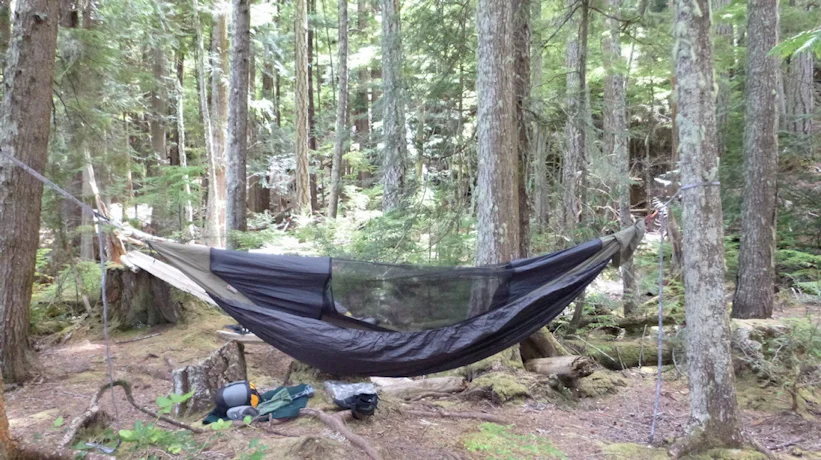
The location was Denham Island in the Broughtons Group 50° 47.230' N 126° 29.185' W (ish)
Hammock is an Envoy-S, no longer made by a company called Hammeck (yes, that's their name). It was a family endeavor, but various financial dynamics - nothing to do with quality or design - caused them to fold. I'm posting the photo because many of Hammeck's innovations now appear in other vendors products.
HammockDunham.webp

Notice that I'm not at all concerned with what is under the hammock. But I do want the trees far enough apart to easily hang the tarp.
And I want the side area clear so I can guy out the tarp.
You are looking at the hammock with an underquilt (UQ) attached and a black underquilt protector (UQP) over the UQ.

The mesh area is thoughtfully tricked out. The mesh can be unzipped around its perimeter, but it stays with the hammock and can be stuffed in a bag hanging from the ridgeline. Or, there is also an inside nylon screen/wind break that follows the mesh zipper. With that closed, you have complete privacy and wind protection inside the hammock. As with the mesh bug net, you can unzip that wind break partially or completely, and it stores in that same interior bag. The bug net and wind shield can be adjusted from inside the hammock.

This does not eliminate the need for a tarp. The mesh+shield abates bugs, wind, and light, not rain.
In the past, I'd say the SLD Trail Lair, with its wind shield option, came closest to this design. By now, other vendors offer similar features.

Is this the "Best". Not at all. There is no best. There are only features deployed in different ways. For example, often I hang a removable "cargo" hammock on my sleeping hammock's ridgeline. It's mini-hammock about 3 feet long where I stuff my night clothes and other items I pull out of storage bags as I set up camp. Need my binoculars, or VHF Marine radio - I don't have to keep digging them out of a drybag on the ground. Once they are extracted from their travel storage, they go into the cargo hammock. Other vendors have a similar option called a "sidecar".

If I'm sure it's not going to rain, this is all I need. The mesh keeps bugs away, the panels at the hammock ends keep the moonlight out of my eyes, and the wind shield (not shown in the photo - it covers the mesh area) would stop heat-robbing wind. The zipper arrangement allows me to adjust ventilation to minimize or eliminate condensation.
 
Last edited:
That is a good set up. Thanks for the tips.
 

Latest posts

Back
Top