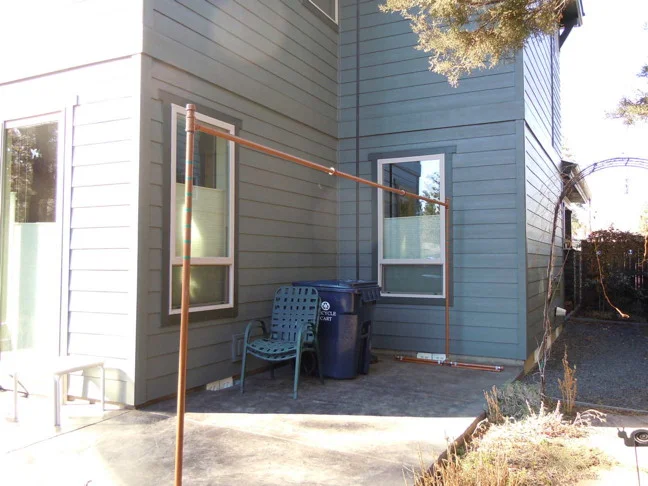
Allen, You are welcome

I reread the posts from the beginning and noted the 290 lb requirement. One stand style you might come across that I didn't put a link to, and may work better with that requirement, is one that has a wooden beam base and "arms" that come up at an angle at the ends. There are some real advantages to that. Though it might be a bit heavier and awkward to move around, it is move-around-able. and for some (I'm not one of those guys) wood is easier to work with and usually less expensive than metal. A 10 ft Rail Fence pipe was $10 when I started. Now they are $25.
Using 4x4's and/or something larger than 2x4s, you can build a frame in the same shape as those Amazon stands, but sized for your hammock and preferences. Use the hammock hang calculator here:
https://theultimatehang.com/hammock-hang-calculator/
to determine distances, like height above ground. One of the pleasures of hammock camping is the ability to sit up, put your feet solidly on the ground and stand up. For me, that's about 18 inches above the ground. But I'm short little critter (you really do shrink a bit as you ... mature). So find the most comfortable chair or couch you've ever gotten up from and measure how the seat height. Then you can size your stand to give you the sag you need at the height you prefer.
"... the sag you need?" This is where it's helpful to have TIH - time in hammock. A usual starting place is the hang the hammock so the end-to-end distance is about 83% of the physical hammock length. For an 11-foot hammock that would be about 9 feet. But some like it a tad tighter, some a bit looser to give them comfort in the diagonal lie. So it's all "ish's" and "abouts" - no magic absolute number.
Note that at 83%, that gives about a 30° hang angle and that gives about a 1 to 1 ratio of weight in the hammock to stress on the supporting structures. If you go shallower than 30°, like 25°, 290 lbs in the hammock increases to 342 lbs on the support (including the end stitching for the connecting loop. Be sure you check the rating of all the components. But most of that is hardware and lumber, and you already had a hammock that fit your requirements.
Here's a bipod 2x4 stand - I think the legs really need a limiting cord/chain; there's a lot of force wanting them to spread out.
https://tinyurl.com/9d7u6fje
Here's the style I'm thinking of:
https://tinyurl.com/38h4ahkf
And here:
https://tinyurl.com/38tufpdb
Note that in this style, the arms can be attached using two bolts. That way, you can undo one bolt and the arm will pivot on the other bolt, folding so it is parallel to the base - making for a compact package.
As Colombo would say, "One last thing sir ..." All those "overhead" stands, unless they have angled bracing at the ends, are subject to racking - swaying parallel to the ridge pole. It's a plus and a minus. It's a minus because the sway is a bit disconcerting. You'll start to question the strength of the joints connecting the legs and you wonder if compression on the ridge pole will cause it to explode; not what you want to consider as you (are trying to) fall asleep. It's a plus if you say a prayer at the end of the day, before you fall asleep, because it will be much more fervent.