• You're one step from joining Hammock Camping Forum – Ultralight Gear, DIY Setups & Backcountry Tips.
    Create a free account to post, follow threads, and never miss an update.  Sign up free →

Looking to replace my Amazon stand with something stronger

Allen Burger

Member
Joined
Sep 19, 2025
Messages
5
My girlfriend started using my hammock setup during summer evenings and now I barely get time in it, so I'm planning on getting an 11' hammock for myself. I tried extending my Amazon stand with a fence post but it bent under my weight (around 290 lb). Is there a reliable backyard stand for longer hammocks that can still be moved around for mowing?
 
Finding a stand that works, and is less than $100 takes a bit of research. Problem is, most of those stands are designed for afternoon lounging and smaller hammocks. If it is long enough for an 11 ft hammock (hung at 83% of physical length = 9 ft.) you often will end up a few inches off the ground. But off the ground is off the ground.

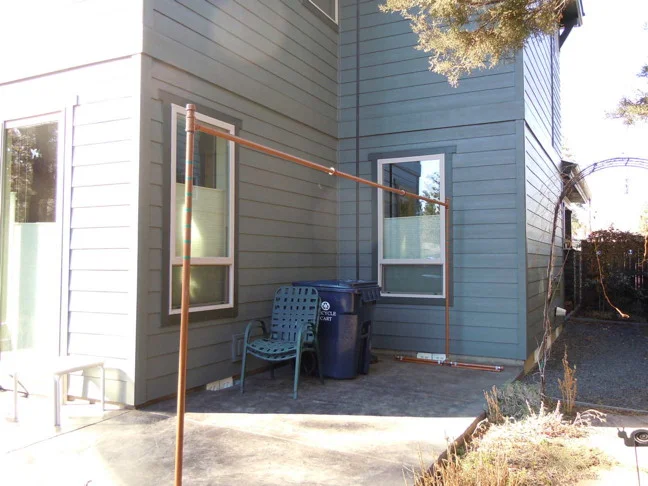
Here's a "pipe stand", I made long ago.
PipeStand.webp
 
I agree with @cougarmeat there. DIY pipe stands with thicker gauge, those are way sturdier than fence posts and still portable. What kind of hammock are you pairing it with?
 
It has some subtle tricks. You'll note the joint along the ridge pole. That's to swap out shorter/longer piece for hanging the usual 11 ft-ish, gathered end (GE) hammock or the longer suspension of a RidgeRunner Bridge Hammock (recommended distance between suspension apex point is 13 ft-ish). So it could be 12 ft or 15 ft long. Why not just leave the long piece on? It feels a little more solid with the shorter ridge pole - though I'm sure it would be fine with either size.

Also note the top of the vertical pole is a "T", not a "U", I put a cap on the T. So I can put a daisy chain loop over that top piece, then run it down the lenght of the vertical pole to the height I wanted - you can barely see the green tape I used to mark the height from ground in inches - and put a half-hitch at the desired point to hold the daisy chain there.

It was a bit heavy and awkward to assemble with all the pipe twisting. But the awkwardness was user error. On reflection, I could have used some "lock-tight" product to make some joints permanent. I could have also numbered the pieces in "add this now" order, making the assembly more efficient.

As you might imagine, there's a bit of "racking" motion (movement parallel to the rigid pole) that can be, and should be, disconcerting. But if one is careful, it's just for a moment. A diagonal brace at the corner where the vertical pole meets the ridge pole would stop that. But as Harrison Ford said-ish, in Six Days and Seven Nights, "I'm not one of those guys ...".

Note the 90° to the vertical pole pipe base. With the galvanized pipe, this project was on the heavy side. I could still lift and move it, with all the grace of handling something 12 ft long. A new design uses lighter Fence Rail poles. It has two 90° brackets per end. Those brackets hold the vertical supports but they are angled out so they look like an inverted "V". I haven't used that yet because I need to finish it with an eye-bolt down by each "foot" that I connect with cord or chain to keep the legs from spreading - don't just rely on a Set-Screw holding the angle on the ridge pole. But I'm not one of those guys. DIY is a challenge for me.
 
Last edited:
Look for a stand that has a capacity rating that works for you and is a foot or two longer than your hammock's total length. Many of the stands designed for two person hammocks are built with a stronger steel frame and can handle a weight of 450 pounds or more. Brands like VEVOR and Sunnydaze have stands that fit 11 ft hammocks. These stands often use a simple, interlocking pipe design which makes them easy to assemble and take apart. This is a great feature for when you need to move it for yard work.
 
Thanks everyone for the great advice especially the detailed breakdown of the DIY pipe stand from @cougarmeat. Seems like that's the sturdiest option to handle an 11’ hammock.

I noted your comments about the original build being heavy but still movable and the point from @caldwell-0100232 about interlocking designs. For those of you with DIY pipe stands, do you typically break them down for storage or just "walk" them to a new spot when you need to mow? I'm trying to decide between a build that's lighter and easier to move fully assembled, vs a heavier 1 that's designed to come apart easily.

I hope to build and test 1 in the next couple of weeks and will report back with my findings.
 
Allen, before you start, I suggest surveying the options a bit. Remember, there is evolution in design, and a difference between something permanent for the home and something "portable" for car camping. I'll even give a link below to a bamboo stand you could lash to a kayak/canoe.

Consider different base choices. You have the T base where the vertical pole uses a "T" joint to connect to a perpendicular base. You have a "turtledog" variety that uses a Tripod base at each end with the hammock hanging off a ridgeline that's suspended from the tripod. And you have a bipod that uses just two legs at each end instead of three, with a connecting line that keeps the two end legs from spreading out under load. The bipod used 90° brackets that slide on the ridgeline pole. They are positioned with a set screw to give the legs the desired angle. If you don't want to be surprised in the middle of the night, when the set screw decides it has had enough, it's best to connect those legs, near their foot, with a non-stretch cord or light chain. The light chain with small "carabiner" links would allow for easy adjustment of the foot spread for given conditions.

Then you have variations on the DIY Tensa4, with which some have had good success. And I'm sure homebrew copies of the YoboGear Turtle Bug will start showing up.

Unfortunately, I wasn't able to find the exact URL that shows a completed DIY Bipod stand - but I know it's out there. There's nothing wrong with the T stand, and a fence rail pipe may be just as worthy as the heavier galvanized pipe for the ridgeline. But I'm not a structural engineer. I just want you to be aware of choices.

** Warning ** if you have any "honeydos", I recommend you complete them first, before heading down those link paths.

Here's a discussion of Turtledog vs bipod:
https://tinyurl.com/4yxzmnp7

Here's a link about a bamboo tripod stand:
https://tinyurl.com/43999ymj

Here are two lins to the concept of a bipod stand:
https://tinyurl.com/yst4c4x2
https://tinyurl.com/mskj7s2w
 
Wow, thanks @cougarmeat that's a ton of great information and resources! You've given me a lot more to research before I start my build. I really appreciate you taking the time to share all of that.
 
Allen, You are welcome :)

I reread the posts from the beginning and noted the 290 lb requirement. One stand style you might come across that I didn't put a link to, and may work better with that requirement, is one that has a wooden beam base and "arms" that come up at an angle at the ends. There are some real advantages to that. Though it might be a bit heavier and awkward to move around, it is move-around-able. and for some (I'm not one of those guys) wood is easier to work with and usually less expensive than metal. A 10 ft Rail Fence pipe was $10 when I started. Now they are $25.

Using 4x4's and/or something larger than 2x4s, you can build a frame in the same shape as those Amazon stands, but sized for your hammock and preferences. Use the hammock hang calculator here:

https://theultimatehang.com/hammock-hang-calculator/

to determine distances, like height above ground. One of the pleasures of hammock camping is the ability to sit up, put your feet solidly on the ground and stand up. For me, that's about 18 inches above the ground. But I'm short little critter (you really do shrink a bit as you ... mature). So find the most comfortable chair or couch you've ever gotten up from and measure how the seat height. Then you can size your stand to give you the sag you need at the height you prefer.

"... the sag you need?" This is where it's helpful to have TIH - time in hammock. A usual starting place is the hang the hammock so the end-to-end distance is about 83% of the physical hammock length. For an 11-foot hammock that would be about 9 feet. But some like it a tad tighter, some a bit looser to give them comfort in the diagonal lie. So it's all "ish's" and "abouts" - no magic absolute number.

Note that at 83%, that gives about a 30° hang angle and that gives about a 1 to 1 ratio of weight in the hammock to stress on the supporting structures. If you go shallower than 30°, like 25°, 290 lbs in the hammock increases to 342 lbs on the support (including the end stitching for the connecting loop. Be sure you check the rating of all the components. But most of that is hardware and lumber, and you already had a hammock that fit your requirements.

Here's a bipod 2x4 stand - I think the legs really need a limiting cord/chain; there's a lot of force wanting them to spread out.
https://tinyurl.com/9d7u6fje

Here's the style I'm thinking of:
https://tinyurl.com/38h4ahkf

And here:
https://tinyurl.com/38tufpdb

Note that in this style, the arms can be attached using two bolts. That way, you can undo one bolt and the arm will pivot on the other bolt, folding so it is parallel to the base - making for a compact package.

As Colombo would say, "One last thing sir ..." All those "overhead" stands, unless they have angled bracing at the ends, are subject to racking - swaying parallel to the ridge pole. It's a plus and a minus. It's a minus because the sway is a bit disconcerting. You'll start to question the strength of the joints connecting the legs and you wonder if compression on the ridge pole will cause it to explode; not what you want to consider as you (are trying to) fall asleep. It's a plus if you say a prayer at the end of the day, before you fall asleep, because it will be much more fervent.
 
Last edited:
Thanks for all the input so far. Running the calculator numbers and checking local suppliers for pipe before deciding between a DIY build and one of the steel frame stands.
 

Latest posts

Back
Top