• You're one step from joining Hammock Camping Forum – Ultralight Gear, DIY Setups & Backcountry Tips.
    Create a free account to post, follow threads, and never miss an update.  Sign up free →

Hennessy Explorer Deluxe 1st trip questions

Edward Squidd

Member
Joined
Aug 10, 2025
Messages
6
Hello! I'm new to hammock camping and used the Hennessy Explorer Deluxe on a trip to the Adirondacks with my dad, who's been tent camping for decades. I appreciated the all-in-one design, but the bottom entry took some getting used to. I'm 5'10" and 180 lbs, and I found the lay decent but not flat enough for side sleeping. Has anyone tried adding a structural ridgeline to improve the lay, and is the stock rain fly enough for multi-day trips or should I upgrade?
 
Edward, welcome to the forum. First, the Hennessy Explorer can be a good starting hammock. For many people, it was their first; it was mine. My concern your size. The Explorer is a bit on the short side. Most camping hammocks are physically 11 ft long. It looks like the Non-XL Explorer is about 9 ft long.

Again, that doesn't make it "bad", but if you continue to "get into" hammocks, you may eventually pick up a longer one (many good used hammocks on various hammock forums).

Though you'll find many variations these days, there are two basic types of hammocks: Gathered End (GE) and Bridge (has spreader bars to keep the hammock like a rectangle. Two common bridge hammocks are the WarBonnet RidgeRunner and the Dutchware Banyon. If a person must sleep on their side, they usually gravitate toward the Bridge style. But don't just go there immediately. ...

One mistaken idea is that you have to sleep in a hammock the same way you sleep in a bed. Not True. Bed sleeping creates pressure points about your shoulders and hips. That can cause you to have a lot of movement at night and require side sleeping. But you might find that the full support of a hammock allows you to sleep more on your back or with just a slight tilt.

The "flat" isn't achieved by stringing the hammock up tight; it's achieved by having a diagonal lie - head a bit right, feet a bit left of the hammock centerline. Some prefer the head left and feet right. Either diagonal is fine.

It's been a long time since I've worked with Hennessy models, but I believe the Explorer has a built-in BugNet. Hammocks that have a built-in net already have a built-in ridgeline. It keeps the owner from hanging the hammock too tightly and tearing the net.

If your Explorer doesn't have a built-in net and you want to add a ridgeline (more detail than this post will deal with), the ridgeline should be the length that will allow the hammock ends to be about 83% of the physical length. For a 9-foot hammock, that would be, when hung, about 7.5 feet end-to-end.

You will find many schools of thought and preferences in the hammock community. You avatar data does not show where you live or where you will camp. Know that the asymmetrical standard tarp what comes with the Explorer will just keep the hammock dry in a not too furious rain. A good "workhorse" - note, I am in the "big tarp" camp, not the UltraLite camp - is the Hennessy Hex tarp. There was a time when, if your standard tarp wasn't used, Hennessy would allow you to trade it in for a retail value credit against one of the other tarps. Also, there's nothing wrong with having two tarps and taking the one most fitting your expected camping situation.

About that split bottom entry - I thought it was great. Just press it open with your legs, put them through and on the ground (assuming hammock is hung at appropriate height). Sit up. Stand Up. And lift the hammock body over you. My opinion, but I think the reason Hennessy offers a zipper option is just to "keep up with the Jones's" marketing-wise.

One thing you haven't mentioned is how you plan on keeping warm. In a tent, heat is lost by conduction (contact with cold objects - the ground) and is prevented with a ground pad for insulation. In a hammock, heat loss is by convection (air currents around the hammock). You can use a sleeping bag as a top cover, but you will be depressing the loft underneath you, so your insulating there is only the thickness of a few pieces of nylon.

There are standard solutions for that, and many of these issues have been covered in various hammock forums and one book - The Ultimate Hang, by Derek Hansen. I could cover some of it here, but all this detail is starting to feel like the story of the little boy who asked his mother where he came from. The Mom sets him down and as gently and appropriately as possible, explains a bit about the birds and the bees. When done, the mom asks if the boy has any questions. He says, "Yeah, Timmy told me he was from Wisconsin. I want to know where I'm from."
 
Last edited:
Wow, thank you for taking the time to write such a comprehensive and informative response to my questions. The shorter length of this model and the absolute need for a diagonal lay is a revelation. I was certainly trying to sleep straight down the middle. The critical topic of bottom insulation, which my dad and I had not considered at all while preparing for the trip. My next step will be to obtain the book you recommended and conduct further research before considering purchasing any new gear. For three-season camping, should I get an underquilt right away or will a sleeping pad work for now?
 
Edward, I wrote a long-ish answer, then, on review, I started disagreeing with it a bit. :)

Tomorrow I'll collect my thoughts better. I do know that Labor Day Sales are going on now, and that's sort of a pressure.

Does your Hennessy open at the bottom, or is it a zipper model? Also, what are the nighttime temperatures you expect during your "three-seasons" of camping?

The bottom line would be to get you in an 11ft, bug-netted hammock with a UQ in the appropriate temperature range, maybe an UnderQuiltProtector, and a good coverage tarp. Because you have a sleeping bag you can unzip to use like a top quilt, it could be the last thing replaced ... or kept.

But you don't have to get there all at once. And you can learn a lot using the gear you have.

How do you suspend your Hennessy? When I saw that knot they wanted me to tie, I thought, "I don't have enough lifetimes for that." You know you usually have to adjust it more than once. So the first thing I did was tie a loop in the suspension line, near the hammock, using a figure-8 knot. Then I used a carabiner to connect it to webbing material that connected to the tree.

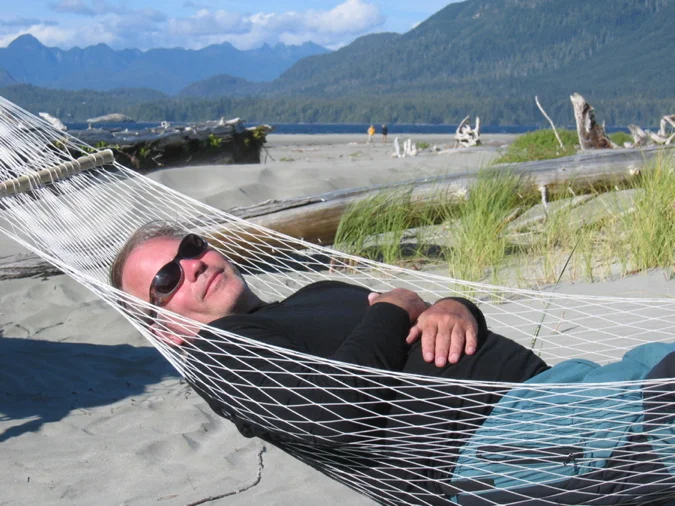
Here is my very first hammock purchased at The Dollar Store.

Vargas Island, west coast of Vancouver Island:
HammockSunGlassesVargas.webp

I'm not getting sunburned. That's just a color artifact from the camera.
I actually slept in Dollar Store hammock at Waldo Lake one summer night - with a light blanket underneath me.

From there, I moved to the Hennessy. Then I think a Warbonnet BlackBird.

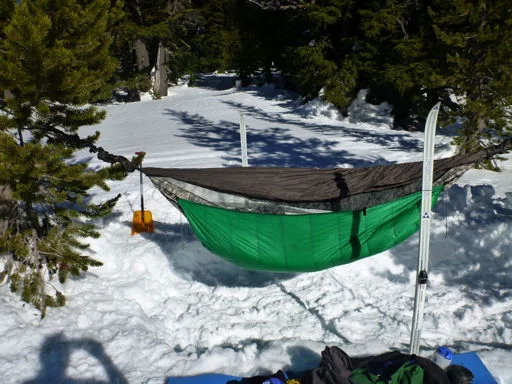
Here's my Hennessy with a Nest UQ by ArrowHead. The Nest has a split at the bottom that matches the split on the bottom entry Hennessy. Otherwise, you have to push the UQ out of the way to get out and move it back into place when you get in.
ArrowHeadNestUQ.webp
 
Last edited:
Edward, here's what I was going to post yesterday. We are heading into the fall season, maybe the tail end of the "three seasons" you mentioned. Maybe the gear you have will work a little bit longer as you get a better idea of the options. Remember, if you are going to use that ground pad inside the hammock, don't inflate it as stiff as you would using it on the ground.

Here's my problem, when I bought my gear is was years ago. An underquilt protector cost $30. Now I've seen them for $100! So it's difficult for me to advise because a lot depends on your financial situation.

For me, I knew there were no "classrooms" for what I wanted to learn. So I'd buy gear, try it out, learn from it. Then, if I was ready to move on from it, I'd sell it at about 30% off the price I paid and chalk the dollar difference up to the "cost of education".

Anyway, "Here's the rest of the story ... "
***************************************************
Edward, do understand that there is no "absolutely correct answer" and there are a lot of opinions. There are also marketing trends. For example, in another field, some kayaks from the UK started appearing with what was called a "Day Hatch" located behind and to the side of the cockpit where you sit. The problem was, you had to be a circus contortionist to twist and reach back to open it. But it was "new". Soon, many new sea kayaks from other vendors appeared with a day hatch. It was "the next new thing."

Along the same line, Hennessy had their classic, "no zippers" opening built into the hammock body. But everyone else's hammocks had a side zipper opening. So Hennessy came out with the zipper opening option. Doesn't make it better (or worse). But it's important to see what's going on.

Superior Gear came out with a hammock with an underquilt sewn to the body of the hammock. Now more and more vendors are offering the same option. Is it better? Maybe for some, maybe not for others. Think about it ... You could have one hammock and have UQ's for winter, spring/fall, and summer. Or you would need three Superior Gear hammocks, each with a different temperature range. If I want to wash my hammock for any reason, I put it in the washer (side loading, without a center agitator). With an attached UQ hammock, I have to consider the details of washing the down fill.

But, if I knew I was only going to use it for most of the summer and some shoulder season, and I normally keep my gear clean (I sleep in light jammies and socks - easier to wash clothes than to wash gear), then maybe a hammock with an attached UQ rated around 30° would be the cat's meow. Less pieces of gear. Always the correct fit.

You are absolutely correct in that bottom insulation is critical. There are a lot of things to consider, and it takes some experience. I'd rather have you wait a bit, then get a UQ and exclaim, "That darned cougarmeat suggested I wait. What took me so long! This UQ is great." then to spend money on something later feel like, "I could have had a V8." (old commercial references).

Here's an idea. Just an idea, not "the best" idea. You already have a sleeping bag and pad. Assuming it's rated for your adventure temperature range, you can put the pad in the hammock and maybe unzip the sleeping bag down to about 2 ft from the bottom (creating a "foot box") and use it as a top quilt. Note that, because it will be open at the sides, it won't be as warm as when it is fully zipped. But it might be warm enough.

This is the least expensive because you are using gear you already own. It will also be the least comfortable, but hopefully still more comfortable than ground sleeping.

Some people then move to a double-layer (DL) hammock. That hammock has an extra sleeve at the bottom that you slide your pad into. That way, it doesn't move around and is usually more comfortable than having the pad in the hammock itself. Also note, when you are using your pad like this, you are using it as an air block. So you don't need to pump it up so it is rigid; you want some flexibility to bend with your shape.. But your Hennessy is not DL. So ....

A next step is to get a UQP (underquilt protector). It's just a sheet of breathable nylon that uses a shock-cord to hang under your hammock body. Some people don't like them and think they are unnecessary. I have them for all my hammocks. You can put your pad in the UQP, which hangs under the hammock body a short distance, so you don't feel the pad at all. The sides of the UQP come up to the sides of the hammock, so you have a little chamber of non-moving air insulation. Plus, the UQP blocks air currents under the hammock.

Hennessy has their own "Super Shelter" - something like that - which is just a UQP with some additional foam you put in it. But you already have a pad so look for just a UQP. There was a company called 2QZQ that sold them for about $30. 2QZQ was acquired by DutchWare. I don't know what UQP's are going for these days.

Then you have the Gold Standard - an UnderQuilt. Though I have UQ's for 0°, 20°, and 40°, after a few years, it looks like - around where I adventure - I'd only need two, a 10° and a 30° to pretty much cover the same months. If I lived in a warmer place and skipped winter, a 40° would most likely do the job just fine. For me, that would be good for 50° nights and above. I know that because I've slept out at home and used a min/max ($10) thermometer to show me how cold it got at night.

Oh - there reason I use UQP's is I have a bunch of hammocks and UQ's that I swap around. If I had just one hammock and one UQ, I could set it up just right and not give it a second thought. But it's fun to play with different toys. Problem is, quantum physics aside, I haven't figured out how to be IN the hammock and OUTSIDE the hammock at the same time to adjust the UQ. The UQP allows me to be a little sloppier with my setup. It also keeps the UQ a little cleaner when the hammock slips out of your hand as you are putting it up and taking it down because the UQP is a barrier between the ground and the UQ. If it's raining, and you have a minimal tarp, you can get some "bounce" under that tarp, and the UQP again protects the UQ. Also, because of the extra wind blockage, it can extend the temperature rating of the UQ.

However ... Another person can say, "cougarmeat, you are all wet. I just rig my tarp (with doors) up close to the hammock. It keeps the hammock dry. It keeps an envelope of warmth. And I've learned not to drop my hammock during setup/takedown." And they'd be right too.
 
Last edited:
Just today, checking another hammock forum, I read some comments about a new vendor's product, the Majestic Hammock. The commenter was 5'9" and said the 10.5 ft Majestic was just great, and 11 ft seemed a little large for him. So you see, there's no "right for everyone" number. You can check for "hammock conventions" (Hammock-Con) in your area. That's a great place to try out models and sizes.

https://www.hammockforums.net/forum/forumdisplay.php/44-Hangouts-Campouts-and-Trip-Planning

I bought my gear long ago. Two of the vendors are now out of business, not due to any product quality issues. At the time, 800-850 fill was top-tier. Now, 900-950 fill is an option. And much lighter (but more delicate - no free lunch) fabrics are available for construction.

Maybe someday I'll have a big clearance sale and upgrade everything. But it all works fine as is. The compulsion to buy is sort of that, a compulsion.

Have fun reading Derek's book. If you have any questions about what you read, ask them here.
 
Thanks so much for sharing your experience and all the details in your recent posts. Your step-by-step explanation of moving from a sleeping pad to an underquilt protector and then to a full underquilt really helps me see what to try next. I also appreciate your advice about the 'cost of education' with gear and being careful about marketing. This fall, I plan to test my current pad on a few short trips, read the book you suggested, and look into a good UQP. For the Hennessy Explorer, do I need a model-specific underquilt protector because of the bottom entry, or will most third-party protectors work?
 
You will have a small issue with that opening - not a "deal breaker" at all; just a little extra awareness.

The only 3rd party option I know of that caters to the Hennessy bottom opening was that Nest UQ shown in a photo above.

But I'm sure people use "regular" UQ's and UQP's all the time. In fact, Hennessy's "SuperShelter" is just a basic UQP with some extra open-cell foam and maybe some bubble wrap insulation added in. There is no "split" in that UQP.

To get in/out, you sort of push it to the side. Now that might be trickier when you're inside the hammock. Maybe there's some old YouTube out there showing it done.

When I was using the Hennessy, I mostly used it with a pad, like you are doing, inside the hammock. So it was easy to slide the pad over a bit Also, I think I only needed a ¾ length pad (an old Therma-Rest Guide), so maybe the opening wasn't even covered.

Maybe there's a maneuver where you use your foot to push the UQ or UQP out of the way. Just something I haven't visited for years. But I do remember is wasn't a big deal.
 
Thanks for clarifying the standard UQP with a bottom-entry hammock. I'm glad it's a minor issue and that the solution is just to push the protector aside. The book you recommended, The Ultimate Hang, arrived recently. I've already learned a lot from the first chapters. The book's illustrations and explanations reinforce many concepts you've shared with me.
 

Latest posts

Back
Top