• You're one step from joining Hammock Camping Forum – Ultralight Gear, DIY Setups & Backcountry Tips.
    Create a free account to post, follow threads, and never miss an update.  Sign up free →

Hammock straps recos

coffeegrinder0

New member
Joined
May 23, 2025
Messages
2
What brand of hammock straps would you recommend if you're a camper on the heavy side? Would like it to be strong but a bit lighter if there's such thing? Thanks!
 
Wider polyester straps, like the ones ENO makes, such as the Atlas or Atlas XL, because they distribute weight well and are rated for 400 pounds, although they aren't the absolute lightest on the market. You might also check out some cottage industry brands like Warbonnet Outdoors or Dutchware Gear; they sometimes use materials like Dynaweave or have special buckle systems that can shave off ounces while still being plenty burly, just gotta read those weight ratings carefully.
 
coffeegrinder0 - note that "straps" is a very wide term. You have your basic polyester strap with a loop on one end - note that in the past, ENO's straps were made from nylon and had too much stretch. For a long time now, they've switched to less stretchable polyester. I'm mentioning that in case you also look at generic webbing for a solution. Don't use nylon.

The strap circles the tree, through the loop at one end, is cinched tight. The hammock is attached to the remaining tail via either some webbing grabbing hardware device or tying a knot.

Then there are tree-huggers. Those straps are made in lengths intended to just go around the tree and connect to a suspension line from the hammock. As such, they have a loop sewn on each end. The webbing goes around the tree, through the loop at one end, cinched tight, and the hammock connects (like with a carabiner) to the loop at the other end of the hugger. Usually, you'd need some other line - additional webbing or Whoopie Sling - to go from the hammock loop to the hugger.

Then there are daisy chains (often around 10 ft). For me, these are the simplest. The "chain" goes around the tree like a hugger, but is longer with loops sewn every 3 to 6 inches down the remaining length. You connect with a carabiner clipped between the loop at the hammock's end and the best loop along the chain to give you the desired sag.

I think ENO's chains are called Atlas straps and Kammock's chains (both sold at REI) are called Python straps (because they are long and grey).

I recommend a daisy chain if the load is on the heavy side because with the sewn loops and carabiner, there's nothing that will slip. With flat webbing, you are either tying knots or using some hardware to grip the webbing. To me, that just adds another potential point of failure to a suspension system that is approaching its design capacity.
 
Last edited:
Thanks for the detailed explanation @cougarmeat

have you found a big difference in packability or weight between the different daisy chain options like the Atlas vs. Python straps?
 
Lizardine555 - remember, it's all evolution. If I were forced to pick, I'd say the Atlas straps are a bit lighter and less bulky. *BUT* that was when I bought them years ago. At that time, the standard length was about 9 ft. and the loops were 5 to 6 inches apart. I made a 6-inch Amsteel loop I could double over in the chain loop and carabiner to it. That gave me a 3-inch adjustment ability - a half-step - between the sewn loop steps.

These days, vendors like Dutchware have daisy chain of much lighter material and with closer to 3-inch sewn increments. I use my old Python Straps for short day hikes or drive-to areas - like the parking area at South Beach, Elk Lake, Bend OR.

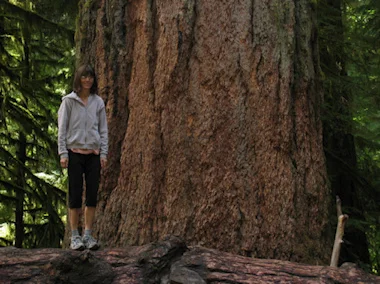
I live in the Pacific Northwest. We have TREES.
That's a treeX.webp


If I'm going to a new area, and I'm using Daisy Chain, I'll bring 12ft to 15ft lengths.

To be clear, there is nothing wrong with Atlas or Python straps. It's just that there are alternatives if you are looking for a lighter and less bulky chain. Also, with Python and Atlas, the chain does extend the full length of the webbing. One end is the "around the tree" end, and the loops start about 2 ft down from that. The problem is that if it's a small tree with tight spacing, using that "wrap-around" end starts the first loop too far from the tree. The easy solution is to turn the chain around and wrap the tree with the "tail" end so the chain loops start just about at the tree. It is only an issue if the trees are small and the distance between is minimal.
 
Last edited:
Wider polyester straps, like the ones ENO makes, such as the Atlas or Atlas XL, because they distribute weight well and are rated for 400 pounds, although they aren't the absolute lightest on the market. You might also check out some cottage industry brands like Warbonnet Outdoors or Dutchware Gear; they sometimes use materials like Dynaweave or have special buckle systems that can shave off ounces while still being plenty burly, just gotta read those weight ratings carefully.
oh, I'm using ENO too. very easy to set up with their daisy chain system, and they are tree friendly!
 
My window for editing a post has passed. I meant to say, the chain loop for the Atlas Straps and the Python straps DO NOT (doesn't) extend to the full length of the chain. There's an assumption that you'll be wrapping one end around the tree, so you don't need loops going the full length of the chain. The problem is, if the tree is on the skinny side (but of course sturdy enough to do the job), and your two trees are close together, that "loop-less" tail may extend out from the tree, just where you want to clip in. In that case, wrap the tree with the "chain" end, and the loops will start right at the tree.
 
Ah, got it! So, the loops don't run the full chain length. If the trees are close together, just wrap the chain end around the tree to make it work.
 
sway&stay. Bingo!

Two things: First, that 3-inch number for the alternate daisy chain is an approximation. It is definitely smaller than Atlas or Python.

Second, you'll want a method for getting the sap off your straps. It's not "if" you get sap on your straps; it's "when" you get sap on your straps. Search videos for different ideas. I keep them in a separate bag on the trail, and put them in the freezer when I get home. The sap hardens and can be peeled off. You might want some kind of glove to wear if you frequently camp in sappy areas. You've probably learned that once you get tree sap on your hand, it has a way of transferring to everything. I don't even think you have to touch the object. It's some kind of quantum magic. Just bring your hand within a quarter inch of another object, and it too will obtain tree-sappiness.
 

Latest posts

Back
Top