xerofang, the lore (and hammock camping "plus" over a tent with a rainfly) is you set up the tarp first so you can do everything else while dry under the tarp. There is one YouTube video that exaggerates that feature by showing a guy setting up his tent in the rain. By the time he gets the tent laid out, then puts in the tent poles, then attaches the fly - all while he is in the pouring down rain - everything is wet. And there is no way he can help but bring some "wet" in with him because as soon as he is out of the tent, he is in the rain. After all, no "ultraliter" wants to carry the weight of a reasonably sized vestibule.
It does show the worst case, but I remember once, in the olden days before there was dirt, when two friends and I had to set up a tent in the rain. Or rather, I set up the tent because they reasoned there was no purpose in everyone getting wet, so they waited in the car. What are friends for?

But ... I'd wager most of us set up in good weather. And for me, it's easier to get the Hammock just right first, then center the tarp over it. I'll occasionally do the tarp first, just for practice and to see if there are any different dance steps I have to do in that situation. But again, when I go-a adventuring I plan for good weather or to take the difficult weather at the end of the trip. So, in the bad weather case, I'd be packing up in the rain.
Because of the tarp, I'd say I have a definite advantage over my tent-dwelling companions. Except ... one thing kayak campers learn is tent or a hammock, it's best to put a tarp over it. I saw this at a Kayak Camp on Orcas Island in 2003. Several participants put their tent up, then put a tarp over the tent. I asked why they did that because the tent already had a rainfly. They pointed out the advantages of a tarp, even with a tent, mentioned above. It gave them a dry space outside the tent and, should it be raining, they could pack everything up dry (under the tarp), then do the tarp last. With overhead sun, it gave them a shady place outside the tent. I thought I'd seen everything and I'd been to two rodeos and a circus.
So it's good to practice putting the tarp up first a few times. Then you can go back to setting up the hammock first, as I'm guessing most people do.
My hammocks have a structural ridgeline so I don't have to figure out any angles. I suspend it so the ridgeline is just snug. Then I sit in it to check the height above ground. I want to be able to swing my legs over, plant them flat on the ground, and stand up. For me, that's about the height of a chair - about 18 inches.
The last thing I do is raise the foot end up about 6 to 8 inches. That's because there's a tendency, during the night, to slide toward the foot end a bit. A slight rise of the foot end stops that tendency. One vendor, WarBonnnet, recommends an 18-inch difference for their BlackBird style hammock. That hammock is specially cut so on the diagonal the feet have support out the side. You can look into the detail of the BlackBird if you want - too much info for this thread.
From reviewing others' posted photos, I think I string my tarp (on its independent line, not attached to the hammock suspension) higher than most. And I usually put it in "porch mode" by using one or two collapsible poles to lift one side up like an awning.
But ... there is no "right" way. It's all about making adjustments given the weather, the view, and what territory others with you might need. If I'm with a tent camper, I give them the first shot because their requirements are more restrictive.
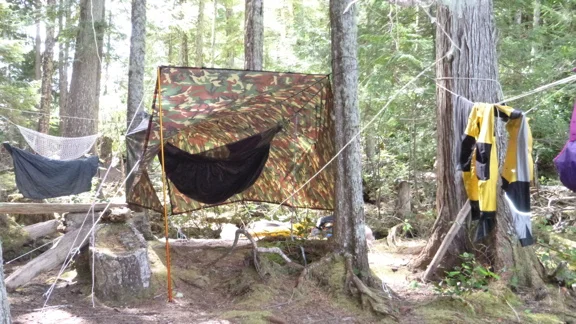
My Hammock site on Denham Island.
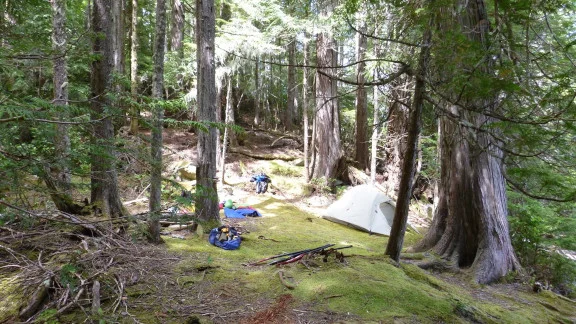
Steve's tent site. Flat ground but a bit of a slope.