• You're one step from joining Hammock Camping Forum – Ultralight Gear, DIY Setups & Backcountry Tips.
    Create a free account to post, follow threads, and never miss an update.  Sign up free →

Darien Dream Hammock setup tips

xerofang

New member
Joined
Aug 3, 2025
Messages
4
Kinda new to hammocking and just got a Darien Dream Hammock, we're loving it so far. I'm using it with an MLD Cuben asym tarp and wondering what the ideal lengths are for all the tie-outs, including the ridgeline and side lines . Also, whats the best way to tie out the tarp along the ridgeline?
 
Xerofang, there's a plethora of info on this and other hammock forums, as well as YouTube videos and some books. I'll send you a direct message because I don't want to post the same info over and over, and I am sensitive about mentioning one forum while in another, though it isn't a competition.

The basic "truths" are ... You get a flat lie, not by stringing the hammock up tight, but by turning a bit diagonal to the hammock center line; head on one side, feet on the other. Some people like their head on the right side, others prefer their head on the left. To allow for this flexibility, the hammock is usually strung up so that the distance between the ends is approximately 83% of the physical hammock length. For example, if it's a 10-foot hammock, you'd hang it so the ends are about 8 feet apart.

One way to approximate that is to hold your hand up to the suspension coming off the tree. Form your hand like pointing a gun with the support line touching your upraised thumb. It should cross the tip of your extended index finger. Note, it's just a starting point. You make little adjustments from there. Each person/hammock pair can have their preferred sweet spot of comfort.

Most people have a separate suspension for their tarp. That way, if it's raining, they can put the tarp up first and finish the job under the tarp. Some people like to have a continuous ridgeline - one line from tree to tree with the tarp hanging off it and movable via prusik knots or hardware on the line. Others like a split line - each end of the tarp has its own support line.

You have a Cuben asym tarp - that's going to be one of the lightest, but also the smallest coverage setups. I'm of a different school. I like a bigger "dry" footprint and am not concerned about a few more ounces. Some people like chocolate chip cookies, some like oatmeal raisin. We can get along just fine. :)

Bottom line - there are many ways, not just one right way or right dimension.
 
Kinda new to hammocking and just got a Darien Dream Hammock, we're loving it so far. I'm using it with an MLD Cuben asym tarp and wondering what the ideal lengths are for all the tie-outs, including the ridgeline and side lines . Also, whats the best way to tie out the tarp along the ridgeline?
I agree with @cougarmeat that there's definitely more than one way to get things dialed in!
Personally, I've found that a continuous ridgeline works best for me.
For this one, you need a couple of pieces of line, about 8-10 feet each like he also suggested, unless you're trying to span a really wide gap.
A trucker's hitch on one side and a bowline on the other should work great to get it tight.
I'd also recommend using prusik knots for attaching the tarp since they slide easily for adjustment but they bite down when you need them to hold.
For the side tie-outs on that asym tarp, I'd use about 4-5 feet of cord on each corner.
I think that gives you plenty of room to get your stake placement just right.
 
CampBas1cs - I'm a little confused. You mentioned a continuous ridgeline, but by mentioning TWO pieces of line (one on each end of the tarp?) it sounds like you are describing a split ridgeline with each line going from a tarp end to a support (tree) and hammock in the middle.

UNLESS :) you are spanning the distance between the two trees with the two pieces of line tied together, and then hanging the tarp from that. If so, why not just carry a 20 ft ridgeline cord? I'm not being critical at all; I'm just trying to understand.
 
Last edited:
Kinda new to hammocking and just got a Darien Dream Hammock, we're loving it so far. I'm using it with an MLD Cuben asym tarp and wondering what the ideal lengths are for all the tie-outs, including the ridgeline and side lines . Also, whats the best way to tie out the tarp along the ridgeline?
When setting up your tarp, attach the ridgeline tie-outs about 2 to 2.5 feet from where the tarp meets your hammock's ridgeline. For the side pullouts, make those about 1.5 to 2 feet out, give or take based on the weather. Use a trucker's hitch or adjustable prussik knots on the ridgeline, which makes tightening things a snap. Angle those side panels at roughly 45 degrees to keep you nice and dry if it rains.
 
Xerofang, there's a plethora of info on this and other hammock forums, as well as YouTube videos and some books. I'll send you a direct message because I don't want to post the same info over and over, and I am sensitive about mentioning one forum while in another, though it isn't a competition.

The basic "truths" are ... You get a flat lie, not by stringing the hammock up tight, but by turning a bit diagonal to the hammock center line; head on one side, feet on the other. Some people like their head on the right side, others prefer their head on the left. To allow for this flexibility, the hammock is usually strung up so that the distance between the ends is approximately 83% of the physical hammock length. For example, if it's a 10-foot hammock, you'd hang it so the ends are about 8 feet apart.

One way to approximate that is to hold your hand up to the suspension coming off the tree. Form your hand like pointing a gun with the support line touching your upraised thumb. It should cross the tip of your extended index finger. Note, it's just a starting point. You make little adjustments from there. Each person/hammock pair can have their preferred sweet spot of comfort.

Most people have a separate suspension for their tarp. That way, if it's raining, they can put the tarp up first and finish the job under the tarp. Some people like to have a continuous ridgeline - one line from tree to tree with the tarp hanging off it and movable via prusik knots or hardware on the line. Others like a split line - each end of the tarp has its own support line.

You have a Cuben asym tarp - that's going to be one of the lightest, but also the smallest coverage setups. I'm of a different school. I like a bigger "dry" footprint and am not concerned about a few more ounces. Some people like chocolate chip cookies, some like oatmeal raisin. We can get along just fine. :)

Bottom line - there are many ways, not just one right way or right dimension.

Thanks, thats a super helpful breakdown, i didn't realize the 83% rule was such a good starting point. When you're dialing in your own setup, do you usually tweak the hang angle first, or do you adjust your tarp positioning to get things just right?


When setting up your tarp, attach the ridgeline tie-outs about 2 to 2.5 feet from where the tarp meets your hammock's ridgeline. For the side pullouts, make those about 1.5 to 2 feet out, give or take based on the weather. Use a trucker's hitch or adjustable prussik knots on the ridgeline, which makes tightening things a snap. Angle those side panels at roughly 45 degrees to keep you nice and dry if it rains.
Clear way to lay it out, thanks, i'll give that setup a try next time out. Do you find those distances and angles hold up well in really windy conditions?
 
xerofang, the lore (and hammock camping "plus" over a tent with a rainfly) is you set up the tarp first so you can do everything else while dry under the tarp. There is one YouTube video that exaggerates that feature by showing a guy setting up his tent in the rain. By the time he gets the tent laid out, then puts in the tent poles, then attaches the fly - all while he is in the pouring down rain - everything is wet. And there is no way he can help but bring some "wet" in with him because as soon as he is out of the tent, he is in the rain. After all, no "ultraliter" wants to carry the weight of a reasonably sized vestibule.

It does show the worst case, but I remember once, in the olden days before there was dirt, when two friends and I had to set up a tent in the rain. Or rather, I set up the tent because they reasoned there was no purpose in everyone getting wet, so they waited in the car. What are friends for? :)

But ... I'd wager most of us set up in good weather. And for me, it's easier to get the Hammock just right first, then center the tarp over it. I'll occasionally do the tarp first, just for practice and to see if there are any different dance steps I have to do in that situation. But again, when I go-a adventuring I plan for good weather or to take the difficult weather at the end of the trip. So, in the bad weather case, I'd be packing up in the rain.

Because of the tarp, I'd say I have a definite advantage over my tent-dwelling companions. Except ... one thing kayak campers learn is tent or a hammock, it's best to put a tarp over it. I saw this at a Kayak Camp on Orcas Island in 2003. Several participants put their tent up, then put a tarp over the tent. I asked why they did that because the tent already had a rainfly. They pointed out the advantages of a tarp, even with a tent, mentioned above. It gave them a dry space outside the tent and, should it be raining, they could pack everything up dry (under the tarp), then do the tarp last. With overhead sun, it gave them a shady place outside the tent. I thought I'd seen everything and I'd been to two rodeos and a circus.

So it's good to practice putting the tarp up first a few times. Then you can go back to setting up the hammock first, as I'm guessing most people do.

My hammocks have a structural ridgeline so I don't have to figure out any angles. I suspend it so the ridgeline is just snug. Then I sit in it to check the height above ground. I want to be able to swing my legs over, plant them flat on the ground, and stand up. For me, that's about the height of a chair - about 18 inches.

The last thing I do is raise the foot end up about 6 to 8 inches. That's because there's a tendency, during the night, to slide toward the foot end a bit. A slight rise of the foot end stops that tendency. One vendor, WarBonnnet, recommends an 18-inch difference for their BlackBird style hammock. That hammock is specially cut so on the diagonal the feet have support out the side. You can look into the detail of the BlackBird if you want - too much info for this thread.

From reviewing others' posted photos, I think I string my tarp (on its independent line, not attached to the hammock suspension) higher than most. And I usually put it in "porch mode" by using one or two collapsible poles to lift one side up like an awning.

But ... there is no "right" way. It's all about making adjustments given the weather, the view, and what territory others with you might need. If I'm with a tent camper, I give them the first shot because their requirements are more restrictive.

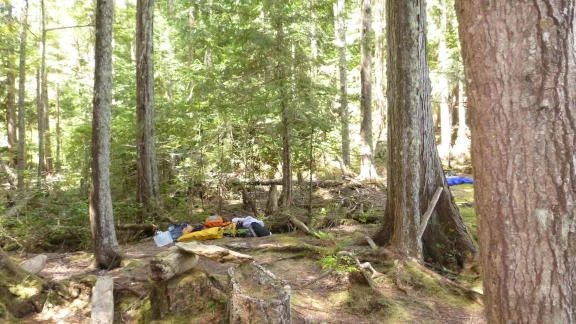
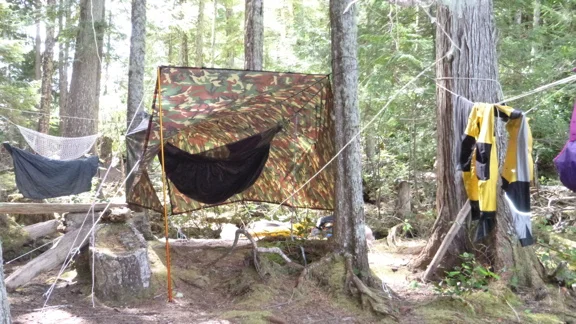
My Hammock site on Denham Island.
DenhamHammockSite.webp

DenhamSetupSmall.webp


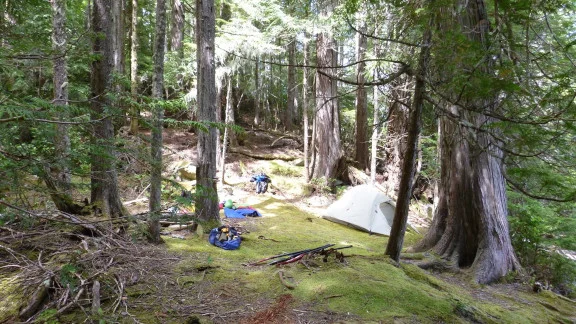
Steve's tent site. Flat ground but a bit of a slope.
DenhamTentSite.webp
 
Last edited:
I really like how detailed this is, setting up the tarp first is awesome when it's wet. And that foot-end lift idea is super helpful for staying comfy all night
 

Latest posts

Back
Top