• You're one step from joining Hammock Camping Forum – Ultralight Gear, DIY Setups & Backcountry Tips.
    Create a free account to post, follow threads, and never miss an update.  Sign up free →

How to Hang Right? Hammock Suspension & Ridgeline Tips

Alan

Administrator
Staff member
Admin
Moderator
Joined
Feb 21, 2025
Messages
147
Welcome to our Hammock Camping community! This guide breaks down the basics of suspension systems and ridgelines so members can hang safely, comfortably, and confidently.

Suspension Systems Explained
Your suspension system is the gear that connects your hammock to the trees.

Different setups offer varying levels of ease, adjustability, and weight savings:
  • Daisy chains: Super easy straps with built‑in loops. Just wrap them around the tree and clip your hammock in. No knots, no fuss.
  • Tree straps: Wide straps that are gentle on the bark. You can pair them with carabiners or whoopie slings to adjust your setup.
  • Whoopie slings: Lightweight rope loops that slide to adjust length. Backpackers love them because they’re simple and great for fine‑tuning your hang.
  • Cinch buckles: Handy little pieces of hardware that let you change strap length quickly. They’re easy to use, though a bit heavier than other options.
  • Continuous loops: Small rope loops attached to the ends of your hammock. They’re basic but versatile, often used together with other suspension systems.
Ridgelines Explained
A ridgeline is a cord that runs above your hammock, connecting the two ends. It sets the sag and can hold accessories like bug nets or organizers.
  • Structural ridgeline: A set‑length cord that keeps your hammock’s sag the same every time. Most folks set it to about 83% of the hammock’s length for a comfy curve.
  • Adjustable ridgeline: This one lets you play around with the sag, so you can fine‑tune it depending on your preference or how far apart the trees are.
  • Accessory ridgeline: Think of this as extra hanging space. it’s perfect for clipping on lights, organizers, or even a tarp above your hammock.

Risks
  • Tree damage: Thin ropes can harm bark, always use straps at least 1 inch wide.
  • Over‑tightening: Hanging too tight increases stress on gear and reduces comfort.
  • Skipping ridgeline: Without one, sag varies each time, making it harder to find your “sweet spot.”
  • Weight vs. convenience: Daisy chains are heavier but simple; whoopie slings are lighter but require practice.
Pro Tips
  • Aim for a 30° suspension angle for comfort and safety.
  • Keep hammock height chair‑level for easy entry and exit.
  • Use a structural ridgeline to guarantee consistent sag.
  • Practice in your backyard before heading out on a trip.

Suspension systems and ridgelines are the backbone of hammock camping. By choosing the right straps and adding a ridgeline, you’ll enjoy safer hangs, consistent comfort, and easier setups.
 
Something to note, I consider Tree Straps and Tree Huggers to be different ideas on the same concept.
For me Tree Straps have a loop at ONE end as they often go through buckles of some sort or are used to tie something like a Beckett Hitch.
Tree Huggers on the other hand have a loop in each end which I find much easier to use. You can connect the Continuous Loops (CL) of your hammock directly to it w/ a caribbeener or soft shackles like you would a daisy chain. Of course they're not adjustable w/ that set up If you use UCRs or Whoopie Slings (the overly long material usage UCR) you would probably want this kind.

I created my own hammock suspension that replaces the three part system ( from tree to hammock - the hammock's structural/adjustable ridgeline - hammock to tree on other end) with One Line that goes from one Tree Hugger (which is only long enough to go around the tree) to the other. The hammock then hangs from that line and is adjusted as to the position and amount of hammock sag.
25' of that line w/ 3 UCRs installed weighs in at 2oz and is longer than I think I'll ever need.
My last trip out my Huggers were only 4' long. A lot different than the 12' straps I started out w/.
 
Something to note, I consider Tree Straps and Tree Huggers to be different ideas on the same concept.
For me Tree Straps have a loop at ONE end as they often go through buckles of some sort or are used to tie something like a Beckett Hitch.
Tree Huggers on the other hand have a loop in each end which I find much easier to use. You can connect the Continuous Loops (CL) of your hammock directly to it w/ a caribbeener or soft shackles like you would a daisy chain. Of course they're not adjustable w/ that set up If you use UCRs or Whoopie Slings (the overly long material usage UCR) you would probably want this kind.

I created my own hammock suspension that replaces the three part system ( from tree to hammock - the hammock's structural/adjustable ridgeline - hammock to tree on other end) with One Line that goes from one Tree Hugger (which is only long enough to go around the tree) to the other. The hammock then hangs from that line and is adjusted as to the position and amount of hammock sag.
25' of that line w/ 3 UCRs installed weighs in at 2oz and is longer than I think I'll ever need.
My last trip out my Huggers were only 4' long. A lot different than the 12' straps I started out w/.
I started out with 12' straps too felt like I was hauling tow ropes! Dropping to 4' sounds way more efficient. Do you find shorter huggers limit your choice of trees, or has it been fine in practice?
 
LowTech will answer your question, but as I thought about it, it's kind of tricky. For me, it depends a bit on the trees. If the webbing is long enough to mostly go all around the tree, then there is little contact with the "sling" suspension line and the tree. But if the tree webbing only reaches around the back of the tree, the sling material will most likely make contact with the tree. And the bark on our Ponderosa Pine is sharp. And a cord under tension cuts pretty easily.

On the other hand, if you have "smooth bark" trees, it's not as much of a concern.
 
I started out with 12' straps too felt like I was hauling tow ropes! Dropping to 4' sounds way more efficient. Do you find shorter huggers limit your choice of trees, or has it been fine in practice?
Here in the desert if I see a tree w/ more than an 8" diameter I'm worshipping it w/ some pagan ritual, so I don't find it a problem and at my last hang I had to go around the tree twice just to shorten the 4' hugger enough to use, oh and that was doubled. Anywhere other than here I wouldn't think of using a tree that small in diameter but here it was probably 20 years old, deep rooted, and had experienced some severe winds.
I always carry two 4' huggers and one 8' in a lighter poly. I can always connect them to make a 12' hugger if needed. If I'm headed somewhere above 6,000" where things like ponderosas grow I'll take my 12' poly straps and at least one hugger. It's a mix & match kind of game . . . What tarp should I bring for this situation? What size huggers? Which ° of quilts, etc
 
LowTech will answer your question, but as I thought about it, it's kind of tricky. For me, it depends a bit on the trees. If the webbing is long enough to mostly go all around the tree, then there is little contact with the "sling" suspension line and the tree. But if the tree webbing only reaches around the back of the tree, the sling material will most likely make contact with the tree. And the bark on our Ponderosa Pine is sharp. And a cord under tension cuts pretty easily.

On the other hand, if you have "smooth bark" trees, it's not as much of a concern.
Agreed! Here I definitely keep my dyneema suspension line off the tree both because I've seen too much thin line tree damage and because I'd rather replace a damaged hugger than my suspension line.
 
Here in the desert if I see a tree w/ more than an 8" diameter I'm worshipping it w/ some pagan ritual, so I don't find it a problem and at my last hang I had to go around the tree twice just to shorten the 4' hugger enough to use, oh and that was doubled. Anywhere other than here I wouldn't think of using a tree that small in diameter but here it was probably 20 years old, deep rooted, and had experienced some severe winds.
I always carry two 4' huggers and one 8' in a lighter poly. I can always connect them to make a 12' hugger if needed. If I'm headed somewhere above 6,000" where things like ponderosas grow I'll take my 12' poly straps and at least one hugger. It's a mix & match kind of game . . . What tarp should I bring for this situation? What size huggers? Which ° of quilts, etc
That’s wild to hear! I’m up in Montana where finding small trees is the challenge, so your “8-inch tree worship” made me laugh. It’s cool how different the gear puzzle becomes depending on the landscape.

I’m curious how you decide your mix‑and‑match setup before you head out. Do you base it mostly on elevation, or do you scout the area first to see what kind of anchors you’ll have?

I’m still figuring out my own system, so hearing how you adapt your kit for such different environments is super helpful.
 
I’m curious how you decide your mix‑and‑match setup before you head out. Do you base it mostly on elevation, or do you scout the area first to see what kind of anchors you’ll have?

I’m still figuring out my own system, so hearing how you adapt your kit for such different environments is super helpful.
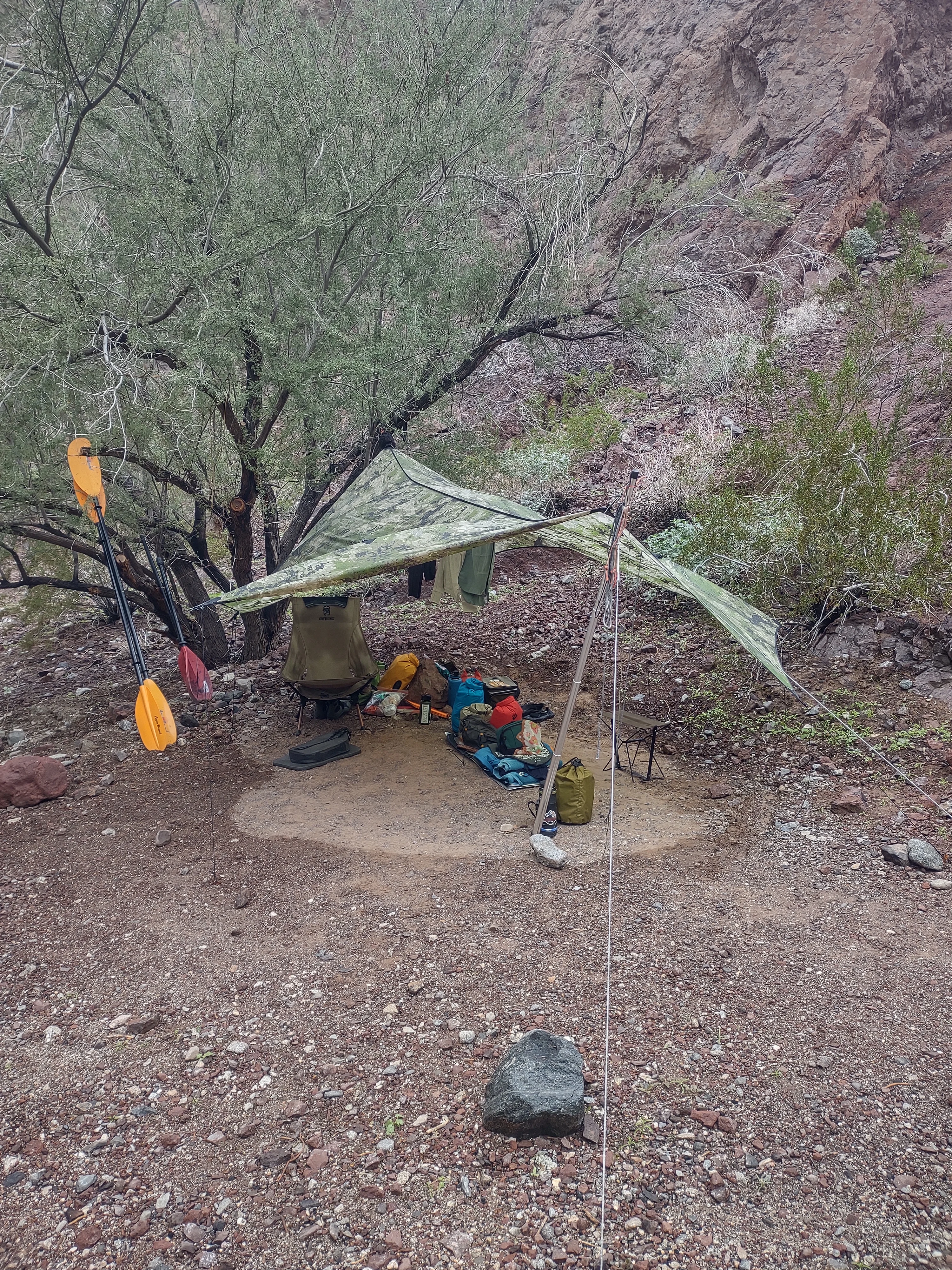
I don't scout the area but of course I've been "scouting" this country and others for the last 45 years. I also do tree shaping work every winter so I pretty much know what types of trees there are in this area and where they grow. On this past river trip I knew that I'd be lucky to find a usable tree at all. So this time I just took my standard kit which is 2× 4' huggers and 1× 8'. As it was I used one 4' and I doubled it, so the equivalent of a 2', and I connected to what would be the ends. If I had used it where I passed one end through the other it would have been longer than I wanted. I was going to take a photo of it but never did. This is the pole end which I don't use a hugger or strap for. I've already taken down my hammock in this photo but it connected to the same place as the tarp, not what a lot of people would call a tree.😆

IMG_20260101_093859138_HDR.webp


Something else to note is that most of my gear is w/ me all the time. Before we leave our base camp (where I live) I put my gear duffel in the vehicle and it has all my standard gear as well as some extras like longer and /or wider straps and huggers, longer tarp ridgelines, extra dry bags and dog bones, that kind of stuff. When I leave the vehicle I can see what type of environment I'm in and I have a good idea if it's going to be different where I'm headed. That gives me the opportunity to change or add some things before heading out.
 
The Journey is specifically SilPoly. Looks like the camo color options come and go. Tunnel Rat is not available at this time, just Woodland Green and Woodland Brown.
 
The Journey is specifically SilPoly. Looks like the camo color options come and go. Tunnel Rat is not available at this time, just Woodland Green and Woodland Brown.
I think it may have been a custom, I'll have to find out. When I looked at their site I saw that as well.
 

Latest posts

Back
Top