As a person who hiked the PCT through Oregon decades ago, I'm always puzzled when people put "ultralight" first. If they need it, if they are going to hike 30 miles a day and set some speed record - sure, not why? Maybe it makes sense. But do understand that there's a price to pay, not only in dollars, for ultralight gear.
Take the Dyneema Tarp for example ... You can pay $335 and get a tarp that is bulkier, non-ripstop, louder in the rain, more translucent (doesn't block the sunlight, moonlight, or give as much privacy as Silpoly) and weighs 5.13 oz. Or you can get a $105 silpoly tarp that is less bulky (packs smaller and is snakeskin friendly) has ripstop to prevent tearing, doesn't sound like BBs on a tin roof when it rains, blocks the sun on a hot day, blocks the moonlight in your eyes on a full moon night, you can change clothes behind it without giving away any secrets, and you'll have $225 more dollars in your pocket. However, it does weigh 12.38 oz. So that's 7.67 - call it 8 oz.
If I'm going to be waylaid by 8 oz, it's time to hang up my hiking shoes.
If someone said, this piece of gear is EXACTLY like that one, but costs about the same and weighs less, of course I'd choose it. But that kind of match is seldom the case.
My point is, comfort and perhaps less concern about the gear's delicateness, might be better criteria to start with. I know it's tempting ... in yesteryear, quilts with 800-fill were the cat's meow. Then it went to 850, then 900, maybe now 950-fill. So if I were considering a new TQ or UQ (top quilt/under quilt) would I go for that? I'd definitely look at them. But again, should weight be the primary criterion?
I live in High Desert country. We don't get a lot of surf. Rain is something I mostly read about. However, once I was camped on Vargas Island up north of Tofino. When I woke up (I was a tent dweller back then), everything was wet; every outside surface was wetted out with dew. If I lived in an area like that, I'd consider synthetic fills over down. And those fills are not in the "ultralight" category.
So a whole lot of "What's the situation/scenario you'll be in?" comes into play.
There's one other aspect ExploreAddition99. How experienced are you with hammock camping? If you are starting out, consider this ... how many first choices do you live with now? Consider your first car, your first intimate friend, maybe your first house, etc. After a year or so of experience, would you pick the same thing, or would your choices be refined by experience? It's important to start, but it's not important to "get it just right" the first time, because that "right" is a moving target. So budget may not be as big a limit for you, but still, maybe get something middle of the road now and plan to spend that budget later, after adventuring for all the seasons of the year that interest you. For example, the gear you pick for mid-summer may be woefully inadequate for winter camping and vice versa.
Anyway, that's enough pontificating. I was just triggered by your starting with "UltraLight" rather than comfort, reliability, and matching the environment you intend to camp in.
Your height, weight, and temperature range you plan to play in are important. For example, if you are in the 6 foot height category, I'd steer you towards a 12 ft hammock rather than the standard 11 ft. If you were below 5' 6", I'd suggest you look at a 3/4 length underquilt because for you, it would be almost full length, with less weight, bulk, and cost of "full-size". The amount of rain you plan to camp in could be important too.
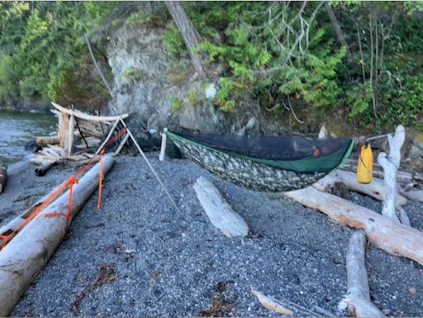
One last example ... I carry a Tensa Solo Pole. It is absolutely NOT Ultralite, weighing about 2 lbs. I can carry 2lbs. With that. I am free from having to find two good trees. I just need one anchor and I can use the collapsible pole for the other. It has widened my choice of camping sites immensely. But it's no free lunch. I've traded looking for that second tree for needing solid ground anchors. Sometimes nature provides - I used a driftwood log in the photo below. Sometimes I need to use ground screws or boomstakes - I'm still learning.
Here it is at Pelican Beach on Cypress Island in the San Juan Islands (Washtington State).
View attachment 12
Yes, the hammock is not hanging at the 30 degree "gold standard".
That's why you have a structural ridge line - for times when the geometry is not ideal.