• You're one step from joining Hammock Camping Forum – Ultralight Gear, DIY Setups & Backcountry Tips.
    Create a free account to post, follow threads, and never miss an update.  Sign up free →

Anyone in camp?

LowTech

Well-known member
Joined
May 4, 2025
Messages
80
Is this now an abandoned fire ring of the side of the trail?
No activity since May. The fires cold and the tracks are starting to fade away . . .
 
Is there activity there?

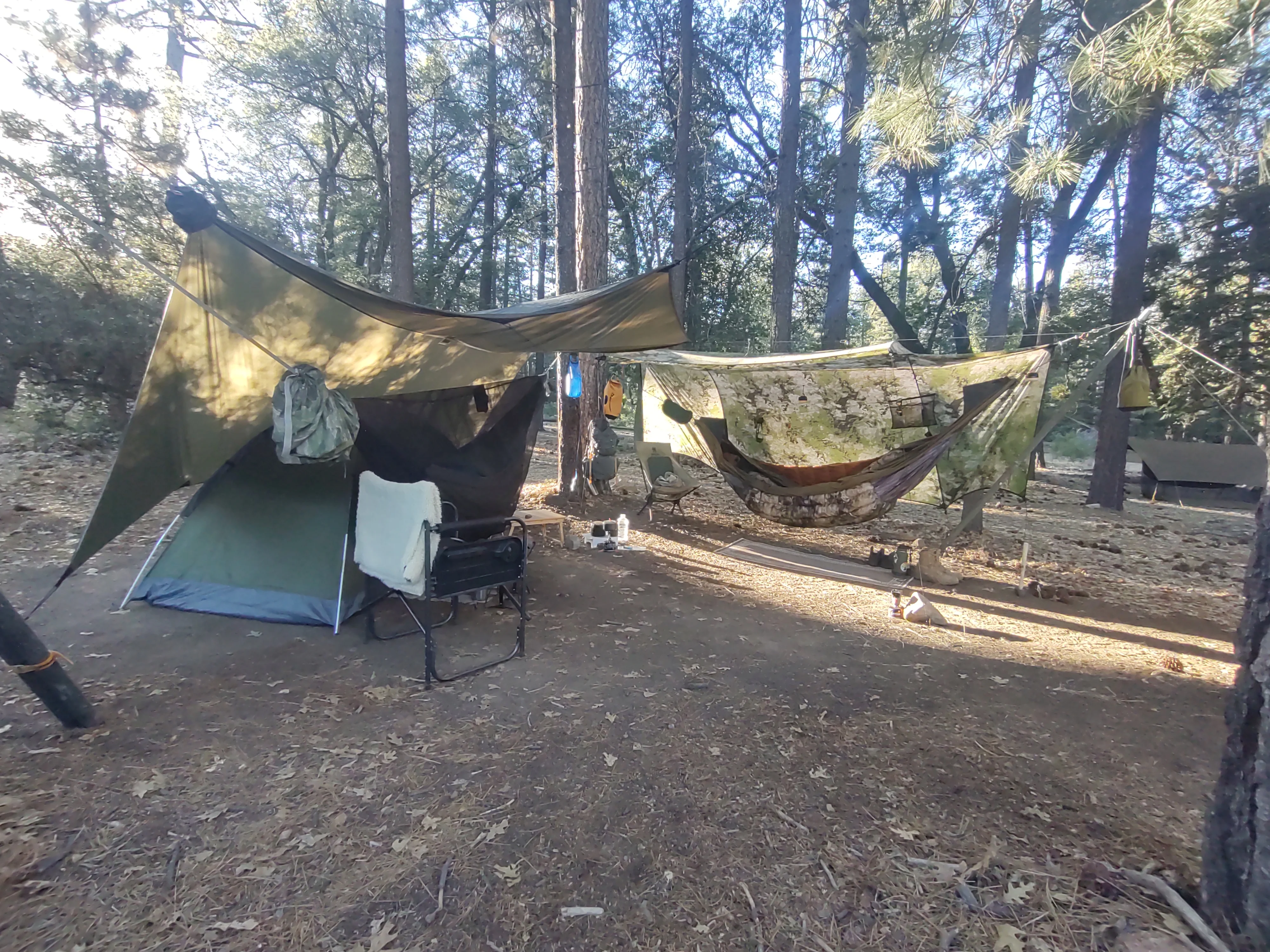
You missed out on HangCon Cali style. Our crew did a good job hosting it. Should of come down.

Tent is for the cat. 😄

1000018492.webp
 
Interesting - when it is cross-posted on Gather, the thread is locked there. So it's just a mirror of here.

Along with hammocks, I have interests in Chess and Ham Radio. In the spirit of our July Celebration, I have to make decisions that will ... insure domestic tranquility. How big is that cat!
 
Looked into that Gather site a bit. It seems like a more modern version of TapaTalk w/ some social media and old school gathering sites style (like the Tribe site) thrown in. Of course you have to be a member to get very far.
It doesn't seem like it bumped up the activity on this forum. 😄

Cat's not big at all but everything has to serve more than one purpose, plus cat related accouterments took up some space and Dusty was still able to sleep in there w/ her if needed. It was her first time somewhere other than our vehicle encampments.
 
Way easy these days. No Morse code requirement. The Technician (lowest level) test is 35 questions, and you can miss 9 and still pass. They are taken from a pool of about 400 questions, and there are study books that list them all.

Local clubs hold classes - either at the club or sometimes at a community college. Often the class is a couple of hours, and the test is given at the end of the class.

The Bummer for me is - as is the way of the world these days - the fees. In days of yore, the license was free. After all, Hams provided a community service when normal communications were down. Or they helped with local events like bike races. Now I believe the license fee is around $35 in addition to what you'd pay for the class.

Recently, the paper exam was replaced by OnLine forms. There is still a test proctor to supervise and guide people through the various forms.

The Technician license allow you use a mic - rather than Morse code - on one low band. It's called "10 meters" and when conditions are right, you can talk to the world with relatively low power. The problem is, those conditions run on an 11 year cycle, and we are headed out of the "good times" But there is still plenty of fun.

Mostly, the technician class allows you to use bands called "2 meters" and "440". I'll spare you the explanation of those terms, but those bands mostly rely on "repeaters" to provide coverage. So you are at point A with your little handheld unit. Because things are mostly line-of-sight at those frequencies, your small unit can reach a repeater that is usually on some hill top. That repeater rebroadcasts your signal, and because it's up high, it has a much larger coverage "footprint".

And ... wait for it ... with that little handheld you can lie in your hammock and talk to locals.
 
Yep. For me it's mostly been an issue of not being in the right place at the right time. I have several 2meter/440 hand-held units that get used when we're out in the kayaks hammock camping or overlanding w/ the rigs. Think I still have a couple base units as well but those are relatively primitive when it comes to using the right pl(?) tone to activate the repeaters.
Still trying to decide on a waterproof set and have read/compared most available units. Think I'll probably go w/ a cheaper set just to get a starter set.

Are you familiar w/ an app called Repeater Book? When you open it it will self populate w/ a list of the local repeaters based on your location. I do that before a launch so that I have them even when I have no cell signal.
 
There seem to be two different "Repeater Book" publications. One is touted by the ARRL, the other is published by [email protected]

The ARRL version used to include EchoLink nodes, but not anymore. The artsci publication does include EchoLink, but only lists one Repeater in Bend.

So my experience with those books/Apps is that the information they contain is, for the most part, correct, but not complete. For example, if you google the HiDARG radio group (High Desert Amateur Radio Group) Repeaters page, you'll see a list of about 30 repeaters.

The big deal around here is "linking". For example the PRA group (Peak Radio Association) has linked repeaters that tie California, Oregon, and Washington, with coverage running along Interstate 5 and most of highways 101, 97, and 20, from Redding, California, north through Oregon to Vancouver/Battle Ground, Washington. The system also covers much of Northern California, Oregon, and Southern Washington.

But you do have to hit one of those in the network. The Desert doesn't provide much in extended footprint because of height, but there probably aren't many mountains blocking the signal.

Once you can operate on the low, HF, bands, look into NVIS antennas. They are purposely set up relatively low to the ground so the signal radiates up instead of out. That way it bounces back down, creating coverage in a radius of several hundred miles - the design is used for emergency communications because you are not trying to contact New Zealand, just have "local" reliable communication without the need for repeaters.
 

Latest posts

Back
Top